The Best Bluetooth Speakers of 2026:Waterproof, and Starting at $40
Bluetooth speakers are a solved category with five distinct personalities: the party workhorse, the tag-along, the style piece, the bass machine, and the cheap champion. We matched measured audio testing to each.
By the BYB Editorial Team
Published July 28, 2026 · Prices checked OctoberOct 5, 2026
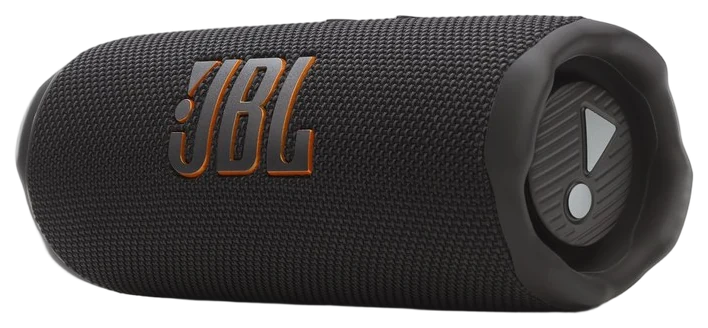
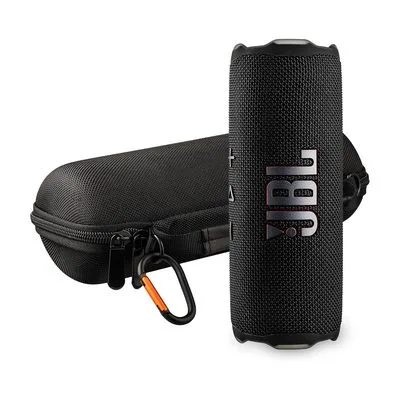
JBL Flip 7$100–130The JBL Flip 7, about $100–130 — loud enough for a patio, small enough for a bag, and rated to survive a pool; little else at the price manages all three.Check price
Bluetooth speakers are a solved category with five distinct personalities: the party workhorse, the tag-along, the style piece, the bass machine, and the cheap champion. We matched measured audio testing to each.
Not sure which fits you? Answer two questions
Right for you?
Which pick is right for you?
Two quick questions. The answer is the guide’s own reason for one of its picks.
How we choseWhat we compared, and how we rank
We compiled measured audio testing (RTINGS, SoundGuys), waterproof-rating verification, and long-term battery reports. Prices are always moving, so every button and link pulls the live listing.
How we rank
Published specifications, verified owner reviews, and independent safety or standards data where it applies — weighted the same for every pick, never sponsored placement.
The JBL Flip 7 is the best-selling Bluetooth speaker lineage on earth because it keeps nailing the same brief: bigger sound than its water-bottle size suggests, a build that shrugs off beaches and bar tables, and a tuning that makes everything sound energetic. SoundGuys’ measured testing backs the reputation up: solid distortion control and bass that punches above its bottle-size enclosure. Reviewers keep reaching the same conclusion. When in doubt, this is the answer.
This generation’s headline is Auracast, which chains dozens of compatible JBL speakers into one synchronized system. Two Flips out-fill a single larger speaker, and a friend group’s worth of them becomes a portable PA. IP68 rating means full dunk-and-dust immunity, and the strap mount clips to bags and bike bars.
The limits: the punchy tuning favors energy over accuracy, the Bose below reproduces voices and acoustic music more faithfully, and battery is a middling 14-ish hours. At around $100 at Amazon, against a $149.95 list, it remains the default recommendation for good reason.
Strengths
Big, energetic sound from a bottle-size body
Auracast links dozens of JBLs into one system
IP68 dunk-and-dust proof
Constantly discounted
Tradeoffs
Tuned for energy, not accuracy
Mid-pack battery life
No speakerphone function
Pick 2 of 5: No. 2Best sound under $150
2
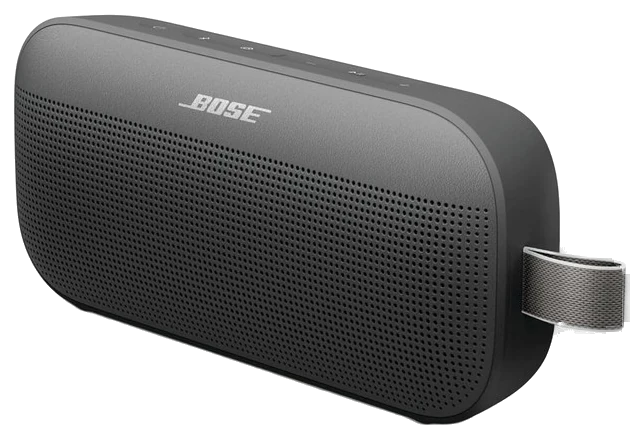
Bose SoundLink Flex
Best sound under $150
The refined one
Get it if sound quality is the reason you’re buying a speaker, and $130 or so (often less) fits the budget.
Skip it if you need volume for groups outdoors. Go JBL or bigger.
Where JBL tunes for energy, Bose tunes for truth: the SoundLink Flex reproduces voices, jazz, and acoustic music with a naturalness the party-speaker crowd can’t reach. RTINGS’ measured testing backs the reputation: it’s consistently rated among the clearest-sounding speakers under $150, and the gap is obvious the moment a podcast or a piano track comes on.
The clever part is PositionIQ: the speaker senses whether it’s standing, hanging from its loop, or lying flat, and re-EQs itself for each orientation: so it sounds right on a shelf, a shower hook, or a picnic table. The powder-coated steel grille has a durability reputation owners rave about, and IP67 covers the dunks.
Trade-offs are mild: it won’t win a loudness contest outdoors, and the roughly 12-hour battery trails the Marshall badly. It sells around $130 at Amazon with regular dips toward $100, at which point it’s the easiest recommendation in the category for people who listen more than they party.
Strengths
Clearest sound under $150, per reviews
PositionIQ self-EQ in any orientation
Tank-grade build with IP67
Compact enough for a jacket pocket
Tradeoffs
Modest maximum volume
~12-hour battery trails rivals
No multi-speaker linking ecosystem
Pick 3 of 5: No. 3Best under $100~$55–80
3
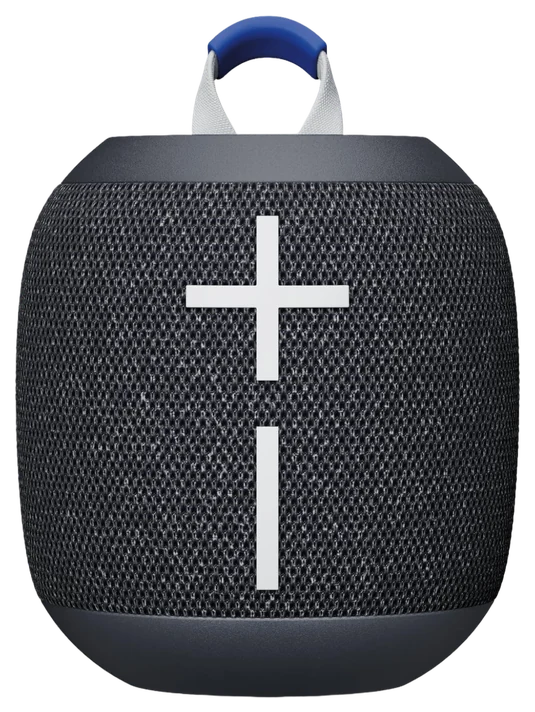
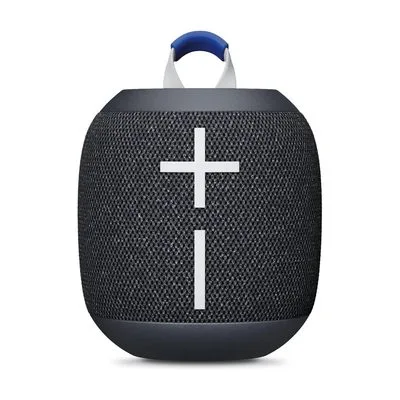
UE Wonderboom 4
Budget pickBest under $100
The tag-along puck
Get it if you want a carefree speaker for pools, showers, and bags, at $55–80.
Skip it if you want app control or serious volume.
The UE Wonderboom 4 is the speaker that lives in a backpack: a dunkable, floating puck that fires sound 360 degrees and shrugs off the drops that kill prettier speakers. It has quietly become the pool and shower standard because it’s the one you never have to think about.
Sound-wise it’s a charmer rather than a champion: balanced, room-filling for its size, with an outdoor mode that lifts mids and highs for open air. The float trick isn’t a gimmick either: pool parties use it as a floating jukebox. Pair two for proper stereo.
It won’t win a loudness war and there’s no app or EQ. This is a one-button appliance. But it wins the being-everywhere war, which matters more, and at $55–80 at Amazon, often under $70, it’s the best casual speaker per dollar on this page.
Strengths
Floats, actual poolside jukebox
360-degree sound, no wrong side
Survives drops that kill rivals
Regularly under $70 on sale
Tradeoffs
No app, no EQ options
Limited maximum loudness
Slow charging, USB-C cable not included
Also on the shortlist
Two more, in brief
Pick 4 of 5: No. 4Best battery + looks~$160–180
4
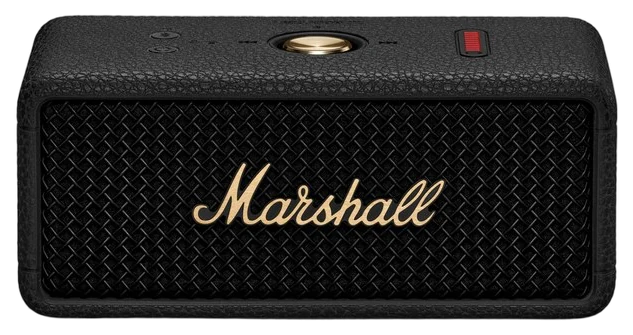
Marshall Emberton III
Upgrade pickBest battery + looks
The one that looks the part
Get it if the speaker will live on a shelf, you value battery + looks, and $179.99 fits a grown-up room’s budget.
Skip it if it’s destined for pools and parties. Buy the JBL or UE.
The Marshall Emberton III is for people who care what the object looks like when the music stops, and the little guitar-amp design is lovely, brass details and all. It’s the one speaker here that earns shelf space in a living room as an object.
It backs the looks with the best battery on this page: 32-plus hours, roughly double everything else here, which changes how you use it. Charge it weekly, not daily. The tuning is warm and rich, suited to living rooms and background listening; True Stereophonic multi-directional sound means no bad seat at the table.
It’s the wrong pick for pool chaos. IP67 covers accidents, but the aesthetic invites careful treatment. At $179.99 list at Amazon, with the outgoing Emberton II still around near $160 for the same look and a little less battery, it’s the pick for grown-up rooms over beach bags.
Get it if the speaker will live on a shelf, you value battery + looks, and $179.99 fits a grown-up room’s budget.
Skip it if it’s destined for pools and parties. Buy the JBL or UE.
The Marshall Emberton III is for people who care what the object looks like when the music stops, and the little guitar-amp design is lovely, brass details and all. It’s the one speaker here that earns shelf space in a living room as an object.
Read the full case
It backs the looks with the best battery on this page: 32-plus hours, roughly double everything else here, which changes how you use it. Charge it weekly, not daily. The tuning is warm and rich, suited to living rooms and background listening; True Stereophonic multi-directional sound means no bad seat at the table.
It’s the wrong pick for pool chaos. IP67 covers accidents, but the aesthetic invites careful treatment. At $179.99 list at Amazon, with the outgoing Emberton II still around near $160 for the same look and a little less battery, it’s the pick for grown-up rooms over beach bags.
Strengths
32+ hour battery doubles the field
Beautiful amp-head design
Warm, rich indoor tuning
IP67 despite the premium looks
Tradeoffs
Premium price for the size
No speakerphone or linking
Warm tuning isn’t for bass-heads
Pick 5 of 5: No. 5Best under $80
5
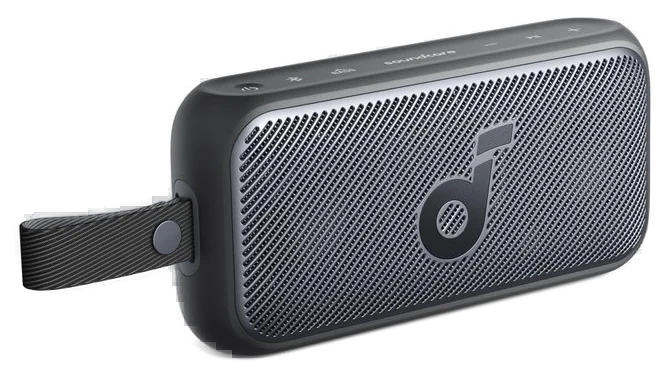
Anker Soundcore Motion 300
Best under $80
The spec-sheet overachiever
Get it if you want the most sound per dollar and like tweaking EQs, for $60–80.
Skip it if maximum loudness or brand design matters most.
Anker did to speakers what it did to chargers: the Soundcore Motion 300 delivers detail and volume that embarrasses its price tier, and SoundGuys keeps measuring it against speakers costing twice as much. Hi-Res certification with LDAC support is unheard of at this price.
The real differentiator is the app: a full custom EQ that lets you reshape the sound signature entirely, a feature the premium brands still ration to their flagships. The default tuning is lively; five minutes of EQ makes it yours. SmartTune adjusts output by orientation, echoing Bose’s trick.
The compromises are subtle rather than deal-breaking: maximum volume distorts slightly earlier than the JBL, and the brand cachet is nil if that matters to you. At $60–80 at Amazon, with near-permanent coupons. It’s the rational pick, and it doesn’t sound like one.
Get it if you want the most sound per dollar and like tweaking EQs, for $60–80.
Skip it if maximum loudness or brand design matters most.
Anker did to speakers what it did to chargers: the Soundcore Motion 300 delivers detail and volume that embarrasses its price tier, and SoundGuys keeps measuring it against speakers costing twice as much. Hi-Res certification with LDAC support is unheard of at this price.
Read the full case
The real differentiator is the app: a full custom EQ that lets you reshape the sound signature entirely, a feature the premium brands still ration to their flagships. The default tuning is lively; five minutes of EQ makes it yours. SmartTune adjusts output by orientation, echoing Bose’s trick.
The compromises are subtle rather than deal-breaking: maximum volume distorts slightly earlier than the JBL, and the brand cachet is nil if that matters to you. At $60–80 at Amazon, with near-permanent coupons. It’s the rational pick, and it doesn’t sound like one.
Strengths
Sound quality far above its price
Full custom EQ in the app
LDAC hi-res support, rare here
Near-permanent coupons under $70
Tradeoffs
Slight distortion at max volume
No linking ecosystem
Plain looks next to Marshall
Start with where you’ll use it, then match size, toughness, and battery to that.
Size for the job: a pocket speaker for the shower and a bigger one for the backyard are different buys, so pick for your main spot rather than grabbing the loudest model.
Check the waterproof rating: look for IP67 or IP68 if it’ll see a pool, beach, or rain; splash-only ratings won’t survive a dunk.
Battery you can trust: ten-plus hours covers most days, and speakers that double as a phone charger are handy on longer trips.
The common mistake: chasing maximum volume; past a point, a clean, balanced tuning you can listen to for hours beats raw loudness every time.
JBL Charge 6 — a bigger, heavier, pricier step up from the Flip 7 we picked; worth it only if you want the extra bass and built-in power bank.
Sonos Roam 2 — it shines inside a Sonos Wi-Fi setup, but as a plain Bluetooth speaker you pay extra for features you won’t use.
Bose SoundLink Max — it sounds terrific, but it’s a large, heavy $300-plus speaker, not the grab-and-go most people want.
Tribit StormBox 2 — good value, but the Anker Motion 300 we chose sounds cleaner for about the same money.
Speaker FAQs
6 common questions, answered.
What does IP67 mean?
Dust-tight and survives 30 minutes submerged in a meter of water. Pool splashes, rain, and sand are non-events. IP68 (JBL) goes deeper for longer. Every pick here carries at least IP67; treat anything less as an indoor speaker.
Can I pair two speakers for stereo?
Within a brand, generally yes. Two Flips, two Wonderbooms, or two Motion 300s pair into proper left-right stereo. Cross-brand pairing doesn’t exist; if multi-speaker parties are the goal, standardize on one brand and its party-link protocol.
How loud is loud enough?
A Flip-class speaker fills a room or soundtracks a picnic for 6–10 people. For bigger backyard gatherings, either link multiple units or step up to a party-class speaker, one mid-size speaker pushed to 100% just distorts.
How long do Bluetooth speakers last?
Batteries are the ceiling: expect three to five years of regular use before capacity noticeably fades, and few models offer replaceable cells. Physical durability is rarely the limit on IP67 models. Owners report these surviving years of beaches and drops. Buy from brands with responsive warranty service, and store speakers charged to roughly half if they’ll sit unused for months.
Which speaker here is best for a party?
The JBL Flip 7 wins this one. The JBL Flip 7 is the strongest single pick because Auracast chains dozens of JBL speakers into one synchronized system. Two Flips out-fill one bigger speaker. The Marshall and Bose picks tune for rooms and clarity rather than raw output; the Wonderboom is a personal-radius speaker, not a party engine.
When do Bluetooth speakers go on sale?
Constantly. This is one of the most discounted categories in tech. Prime Day and Black Friday bring 25–40% cuts on JBL and Anker, and last year’s color of a current model is a near-permanent deal. Unless you need one for this weekend, set a price alert and wait a few weeks; a sale will come to you.
Sources
Who the write-ups above lean on, and where each one is cited.
SoundGuysCited for JBL Flip 7 and Anker Soundcore Motion 300, and in the buying advice.
RTINGSCited for Bose SoundLink Flex, and in the buying advice.
Prices on this page are re-checked weekly — see the full Electronics price index for every product we cover.
Keep reading
Where to go next.
The close calls side by side, then related guides.
New guides, re-ranked picks and the month's notable changes. No weekly filler, ever.
Unsubscribe any time. Your address goes to our newsletter provider and nowhere else — see our privacy policy.
Manage Consent
To provide the best experiences, we use technologies like cookies to store and/or access device information. Consenting to these technologies will allow us to process data such as browsing behavior or unique IDs on this site. Not consenting or withdrawing consent, may adversely affect certain features and functions.
Functional
Always active
The technical storage or access is strictly necessary for the legitimate purpose of enabling the use of a specific service explicitly requested by the subscriber or user, or for the sole purpose of carrying out the transmission of a communication over an electronic communications network.
Preferences
The technical storage or access is necessary for the legitimate purpose of storing preferences that are not requested by the subscriber or user.
Statistics
The technical storage or access that is used exclusively for statistical purposes.The technical storage or access that is used exclusively for anonymous statistical purposes. Without a subpoena, voluntary compliance on the part of your Internet Service Provider, or additional records from a third party, information stored or retrieved for this purpose alone cannot usually be used to identify you.
Marketing
The technical storage or access is required to create user profiles to send advertising, or to track the user on a website or across several websites for similar marketing purposes.