The Best Gaming Chairs:Racing Style Against True Ergonomics
Gaming chairs split into two philosophies: racing-seat looks and task-chair ergonomics wearing RGB clothing. We compared build quality, long-session comfort, and warranty terms across three budgets.
By the BYB Editorial Team
Published July 28, 2026 · Updated · Prices checked OctoberOct 12, 2026
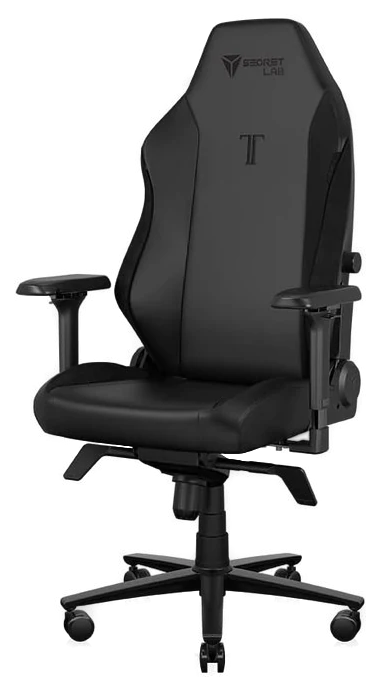
Secretlab Titan Evo$520–670The Secretlab Titan Evo, about $520–670 — the one gaming chair that competes with a real office chair, which the category couldn’t claim five years ago.Check price
Half the money
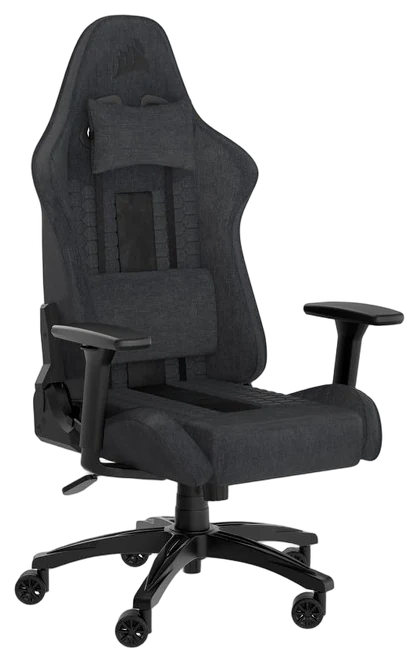
Corsair TC100 Relaxed$200–270The Corsair TC100 Relaxed, $200–270 — where the value sits.Check price
Before you spend big
Price a proper ergonomic office chair alongside it, and buy on how it sits, not how it looks.
Gaming chairs split into two philosophies: racing-seat looks and task-chair ergonomics wearing RGB clothing. We compared build quality, long-session comfort, and warranty terms across three budgets.
How we choseWhat we compared, and how we rank
We compiled teardown reviews, long-session comfort reports, and warranty comparisons across the category. Prices are always moving, so every button and link pulls the live listing.
How we rank
Published specifications, verified owner reviews, and independent safety or standards data where it applies — weighted the same for every pick, never sponsored placement.
CorrectedThe Cooler Master Hybrid 1 left this guide: its Amazon listing has shown “currently unavailable” with no restock date, and a pick nobody can buy is not a pick. The #4 slot now belongs to the Razer Enki X at about $350. The Fujin below remains the mesh recommendation for anyone who runs hot.
NoteThe Cooler Master Hybrid 1 entry published 31.2 pounds as the chair’s weight. That figure is the gross shipping weight in kilograms; the chair is roughly 58 pounds. The same entry credited four measurements to published testing at Tom’s Hardware when they came from Cooler Master’s own specification sheet, and described a 24-inch seat when that measurement spans the outer edges including the side bolsters. The entry was rewritten and re-badged.
Dated notes already published on this page, newest first. Every correction we make is logged on the corrections page.
Secretlab dragged the category from bolstered racing cosplay to legitimate seating, and the Titan Evo is the proof: an internal four-way lumbar system, dense cold-cure foam that holds shape for years, and size-specific builds (Small, Regular, XL) that fit actual bodies instead of averages.
Long-term owner reports are the persuasive part: the foam and stitching hold up at year three where cheaper chairs sag and peel, and the magnetic accessory system (memory-foam head pillow included) is clever. The three-year warranty, stretchable to five through Secretlab’s free redemption program, reads like a materials confidence statement. Wirecutter’s own gaming-chair coverage points to the Titan Evo as the pick that lets you play for hours without getting sore, rare praise from a publication that usually favors ergonomic office chairs over anything gaming-branded.
It’s the one gaming chair that survives the “or a used Aeron?” argument on merit, though at $520–670 at Amazon it’s real furniture money, and the racing look isn’t for every room. If the budget stops short, the TC100 is the sane middle.
The Corsair TC100 Relaxed makes “Relaxed” the entire point: a wider seat pan, gentler bolsters, and a breathable fabric option: the racing-chair look without the racing-seat squeeze that makes broader builds miserable in stricter buckets.
Corsair’s quality control and support are the quiet upgrade over the no-name tier: consistent stitching, hardware that assembles square, and a warranty someone answers. Owners consistently describe it as the chair that made them stop thinking about chairs.
The lumbar is a traditional pillow rather than the Titan Evo’s internal system, and the foam is comfortable rather than exceptional. At $200–270 at Amazon, it’s the sane middle of the market, most chair per dollar for most people.
Strengths
Wider, unsqueezed seat design
Breathable fabric option
Corsair QC and real support
The market’s value sweet spot
Tradeoffs
Pillow lumbar, not internal
One size. Check the fit chart
Foam merely good, not great
Pick 3 of 5: No. 3Best under $150~$100–150
3
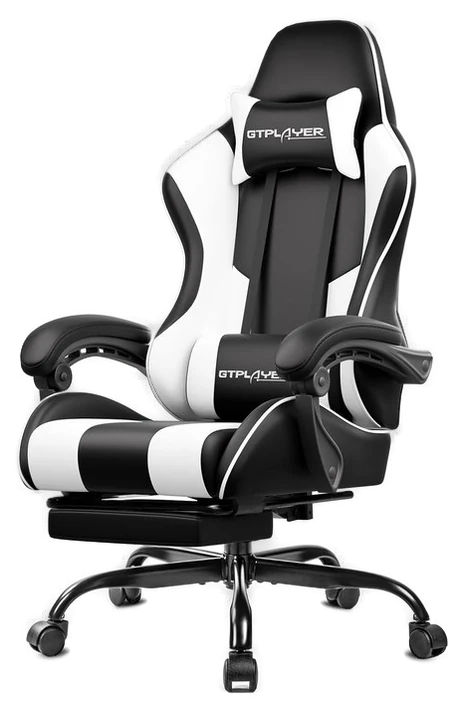
GTPLAYER Gaming Chair
Budget pickBest under $150
The budget footrest favorite
Get it if casual hours and a firm budget describe your setup, at $100–150.
Skip it if you sit all day, every day, invest a tier or two up.
The GTPLAYER is the entry ticket, and it’s honest about it: a reclining back, a pull-out footrest the expensive chairs skip entirely, and tens of thousands of owner reviews establishing that it holds up fine for casual daily hours.
The footrest-recline combination is the sleeper feature. It turns the chair into a nap and movie station the premium tiers never offer, and the massage-lumbar variant adds a vibrating pillow for pocket change.
The materials tell the price truthfully: softer foam that settles sooner, thinner PU leather, simpler adjustments. For students, casual players, and first setups, that trade at $100–150 on Amazon, with coupons routine, is exactly the right one. Heavy daily sitters should start a tier up.
Strengths
Footrest + recline the big tiers skip
Massive owner-review track record
Coupon pricing near $100
Easy assembly
Tradeoffs
Softer foam settles within years
Thin PU shows wear sooner
Basic adjustment range
Also on the shortlist
Two more, in brief
Pick 4 of 5: No. 4Best under $400
4
Razer Enki X Essential Gaming Chair
Best under $400
Set-and-forget comfort without the racing-seat squeeze
Get it if you want wide, shaped, set-and-forget support around $350 with a three-year warranty.
Skip it if you run hot — the Fujin below breathes — or you want lumbar and armrests you can fine-tune.
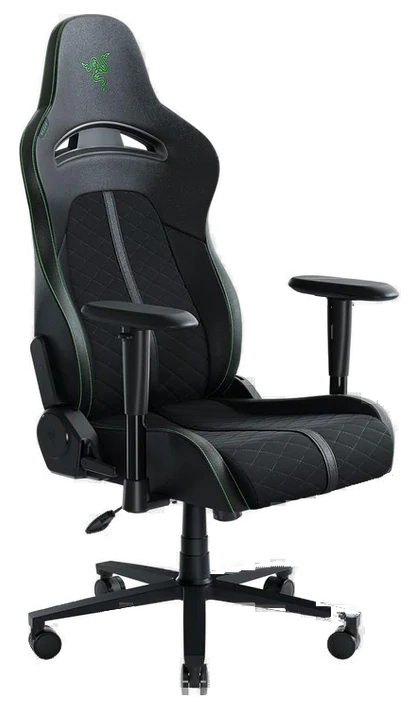
The Enki X takes a different route to comfort than the racing seats above it. Razer shapes the support into the shell instead of bolting it on: the lumbar arch is built into the backrest, the shoulder arches open out at 110 degrees, and the seat base is 21 inches wide, without the aggressive side bolsters that pin larger sitters in place.
The cushioning is dual-density — softer in the seat pan, firmer in the backrest — under a dual-textured cover that puts plush fabric where you touch the chair and synthetic leather at the edges. The backrest reclines to 152 degrees, the load rating is 299 pounds, and Razer covers it for three years — a year longer than the two-year cover that is common at this price.
What you give up against the full Enki, which runs about $50 more: the armrests adjust in height and rotation only, and the lumbar arch is fixed in place — if your back wants the support somewhere else, nothing moves. Owner reviews single out easy adjustability as the most-mentioned point of praise. And a padded back runs warmer than mesh, so if heat is the thing you are solving, the Fujin below is the answer.
Strengths
Built-in lumbar arch and 110-degree shoulder arches encourage a neutral position without any dialing in
Wide, low-bolster 21-inch seat suits bigger sitters that racing seats squeeze
Dual-density cushioning: softer seat, firmer back
Three-year warranty beats the two years typical at this price
At about $350 it undercuts everything else in the top half of this list
Tradeoffs
Lumbar arch is fixed — there is no adjustment if it hits your back in the wrong spot
Armrests adjust in height and rotation only
Padded synthetic-leather back runs warmer than a mesh chair
299-pound load rating
Black with green stitching accents only, so it will not match a color-themed build
Pick 4 of 5: No. 4Best under $400
Razer Enki X Essential Gaming Chair
Set-and-forget comfort without the racing-seat squeeze
Get it if you want wide, shaped, set-and-forget support around $350 with a three-year warranty.
Skip it if you run hot — the Fujin below breathes — or you want lumbar and armrests you can fine-tune.
The Enki X takes a different route to comfort than the racing seats above it. Razer shapes the support into the shell instead of bolting it on: the lumbar arch is built into the backrest, the shoulder arches open out at 110 degrees, and the seat base is 21 inches wide, without the aggressive side bolsters that pin larger sitters in place.
Read the full case
The cushioning is dual-density — softer in the seat pan, firmer in the backrest — under a dual-textured cover that puts plush fabric where you touch the chair and synthetic leather at the edges. The backrest reclines to 152 degrees, the load rating is 299 pounds, and Razer covers it for three years — a year longer than the two-year cover that is common at this price.
What you give up against the full Enki, which runs about $50 more: the armrests adjust in height and rotation only, and the lumbar arch is fixed in place — if your back wants the support somewhere else, nothing moves. Owner reviews single out easy adjustability as the most-mentioned point of praise. And a padded back runs warmer than mesh, so if heat is the thing you are solving, the Fujin below is the answer.
Strengths
Built-in lumbar arch and 110-degree shoulder arches encourage a neutral position without any dialing in
Wide, low-bolster 21-inch seat suits bigger sitters that racing seats squeeze
Dual-density cushioning: softer seat, firmer back
Three-year warranty beats the two years typical at this price
At about $350 it undercuts everything else in the top half of this list
Tradeoffs
Lumbar arch is fixed — there is no adjustment if it hits your back in the wrong spot
Armrests adjust in height and rotation only
Padded synthetic-leather back runs warmer than a mesh chair
299-pound load rating
Black with green stitching accents only, so it will not match a color-themed build
Pick 5 of 5: No. 5Best if you run hot
5
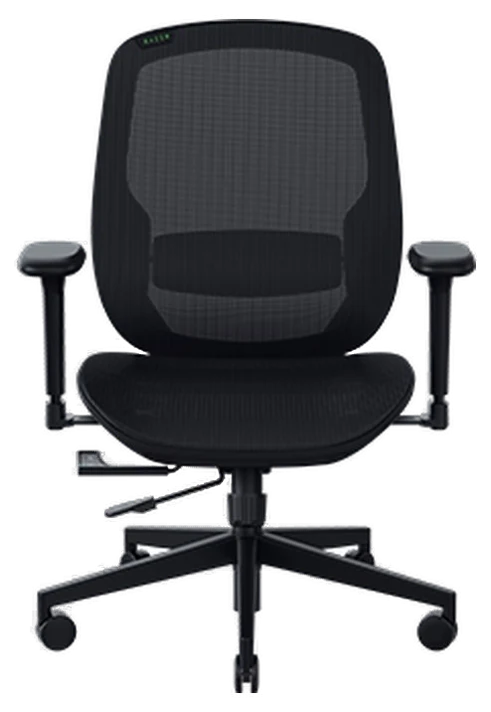
Razer Fujin Mesh Ergonomic Gaming Chair
Best if you run hot
The only pick here where the seat breathes too
Get it if your room runs warm and you have given up on gaming chairs because you stick to them by hour three, and $430–650 fits the budget.
Skip it if you want a headrest included, you weigh more than 300 pounds, or you like to recline all the way back.
Every other chair in this guide wraps foam in leatherette or fabric, which is fine in a cool room and miserable in August. The Fujin is Razer’s answer: a chair where the backrest and the seat pan are both mesh, so air moves through instead of pooling against you. If your setup sits in a warm room or you sweat through long sessions, this is the gap it fills.
Razer lists support for users up to 300 pounds and between 65 and 79 inches tall, so it covers taller gamers than most bucket seats. Synchro-tilt moves the backrest and seat base together as you lean, and the recline goes to 130 degrees. Lumbar support adjusts for height. The armrests move up, down, forward, back and side to side.
Two catches. No headrest is included, and Razer sells one separately, which stings at this price. The warranty also splits: five years on the frame, mechanisms and armrests, but only one year on the mesh backing and seat pan, which are the parts that wear. If heat is not your problem, the cheaper Secretlab Titan Evo is the better all-round buy.
Strengths
Backrest and seat pan are both mesh, so heat does not build up under you
Synchro-tilt and height-adjustable lumbar are office-chair mechanisms rather than styling
Razer rates it for users from 65 to 79 inches tall, taller than most bucket seats
Five years of cover on the frame, mechanisms and armrests
Tradeoffs
No headrest in the box, and Razer charges extra for the optional one
The mesh backing and seat pan carry only one year of cover, and they are the wear parts
300-pound weight limit is ordinary for a chair at this price
Costs more than the Secretlab Titan Evo and reclines to 130 degrees against its 165
Get it if your room runs warm and you have given up on gaming chairs because you stick to them by hour three, and $430–650 fits the budget.
Skip it if you want a headrest included, you weigh more than 300 pounds, or you like to recline all the way back.
Every other chair in this guide wraps foam in leatherette or fabric, which is fine in a cool room and miserable in August. The Fujin is Razer’s answer: a chair where the backrest and the seat pan are both mesh, so air moves through instead of pooling against you. If your setup sits in a warm room or you sweat through long sessions, this is the gap it fills.
Read the full case
Razer lists support for users up to 300 pounds and between 65 and 79 inches tall, so it covers taller gamers than most bucket seats. Synchro-tilt moves the backrest and seat base together as you lean, and the recline goes to 130 degrees. Lumbar support adjusts for height. The armrests move up, down, forward, back and side to side.
Two catches. No headrest is included, and Razer sells one separately, which stings at this price. The warranty also splits: five years on the frame, mechanisms and armrests, but only one year on the mesh backing and seat pan, which are the parts that wear. If heat is not your problem, the cheaper Secretlab Titan Evo is the better all-round buy.
Strengths
Backrest and seat pan are both mesh, so heat does not build up under you
Synchro-tilt and height-adjustable lumbar are office-chair mechanisms rather than styling
Razer rates it for users from 65 to 79 inches tall, taller than most bucket seats
Five years of cover on the frame, mechanisms and armrests
Tradeoffs
No headrest in the box, and Razer charges extra for the optional one
The mesh backing and seat pan carry only one year of cover, and they are the wear parts
300-pound weight limit is ordinary for a chair at this price
Costs more than the Secretlab Titan Evo and reclines to 130 degrees against its 165
You’ll sit in this for thousands of hours, so fit and support beat looks. Match the chair to your body and to how long you sit at once.
Fit your body: Check the seat width, height range, and weight rating against your own size. A chair that’s too big or too small will never feel right, no matter how much you adjust it.
Real lumbar support: Look for adjustable lumbar built into the backrest, not just a loose pillow that slides around. Your lower back is the whole reason to buy a good chair.
Material for your room: Foam and PU leather look sharp but run hot; mesh breathes if you game somewhere warm. Pick for your climate, not the product photos.
The common mistake: Buying purely on brand or looks. A used ergonomic office chair often beats a flashy gaming chair for long sessions, so don’t rule that out.
AndaSeat Kaiser 3 — comfortable for bigger frames, but it’s a heavy, firm chair that can swallow smaller users.
Herman Miller Embody Gaming — the ergonomics are the real deal, but at around $1,500 a used office chair gets you most of the way there for a fraction of the price.
Noblechairs Hero — roomy and well-built, but the PU leather traps heat and there’s no breathable mesh version if you run warm.
Gaming chair FAQs
6 common questions, answered.
Gaming chair or office chair?
For 8-hour workdays, ergonomic office chairs (see our office chair guide) still sit better per dollar. Adjustability beats aesthetics. Gaming chairs win on recline range, footrests, style, and value under $300. The Titan Evo is the genuine crossover.
What makes expensive gaming chairs better?
Foam density and lumbar engineering. Cheap chairs use soft foam that pancakes within a year and pillow-based lumbar; the Secretlab tier uses cold-cure foam that keeps its shape for many years and internal adjustable support. You feel the difference at hour three, and in year three.
Do I need the footrest?
It’s a lean-back-and-watch feature, not an ergonomic one: nice for media sessions, irrelevant for active play. Notably, it’s a budget-tier feature the premium chairs omit; buy it for comfort honesty, not posture.
How long do gaming chairs last?
Two to five years, depending on tier. Sub-$150 chairs typically show foam flattening and PU-leather peeling within two to three years; the Corsair tier stretches to four or five; and Secretlab’s five-year extended warranty tells you what they expect from their materials. PU leather is always the first casualty, fabric options age better in warm climates. Price-per-year, the middle tier is usually the sweet spot.
What size chair do I need?
Check the manufacturer’s height and weight chart, not the marketing photos. Secretlab sizes the Titan Evo in Small/Regular/XL with real cutoffs, and fit matters more than features: a lumbar support in the wrong place is worse than none. Taller than 6’2″ or under 5’4″? The sized options are your list. One-size-fits-all chairs fit the middle of the curve only.
Are gaming chairs good for posture and long sessions?
They’re better than the dining chair they usually replace, with a caveat: the racing-bucket shape encourages a fixed posture, while ergonomic-chair thinking favors movement. Whatever you sit in, the adjustments matter, seat height so feet plant flat, lumbar filling the low-back curve, and standing breaks hourly. The Titan Evo’s adjustable internal lumbar is the feature that translates best from the office-chair world.
Sources
Who the write-ups above lean on, and where each one is cited.
WirecutterCited for Secretlab Titan Evo.
Tom’s HardwareCited in the buying advice.
1Aug 2026Correction, 1 August 2026The Cooler Master Hybrid 1 entry published 31.2 pounds as the chair’s weight. That figure is the gross shipping weight in kilograms; the chair is roughly 58 pounds. The same entry credited four measurements to published testing at Tom’s Hardware when they came from Cooler Master’s own specification sheet, and described a 24-inch seat when that measurement spans the outer edges including the side bolsters. The entry was rewritten and re-badged.Every correction we’ve made ›
18Aug 2026Correction, 18 August 2026The Cooler Master Hybrid 1 left this guide: its Amazon listing has shown “currently unavailable” with no restock date, and a pick nobody can buy is not a pick. The #4 slot now belongs to the Razer Enki X at about $350. The Fujin below remains the mesh recommendation for anyone who runs hot.Every correction we’ve made ›
Prices on this page are re-checked weekly — see the full Gaming price index for every product we cover.
Keep reading
Where to go next.
Related guides, then every guide in the department.
New guides, re-ranked picks and the month's notable changes. No weekly filler, ever.
Unsubscribe any time. Your address goes to our newsletter provider and nowhere else — see our privacy policy.
Manage Consent
To provide the best experiences, we use technologies like cookies to store and/or access device information. Consenting to these technologies will allow us to process data such as browsing behavior or unique IDs on this site. Not consenting or withdrawing consent, may adversely affect certain features and functions.
Functional
Always active
The technical storage or access is strictly necessary for the legitimate purpose of enabling the use of a specific service explicitly requested by the subscriber or user, or for the sole purpose of carrying out the transmission of a communication over an electronic communications network.
Preferences
The technical storage or access is necessary for the legitimate purpose of storing preferences that are not requested by the subscriber or user.
Statistics
The technical storage or access that is used exclusively for statistical purposes.The technical storage or access that is used exclusively for anonymous statistical purposes. Without a subpoena, voluntary compliance on the part of your Internet Service Provider, or additional records from a third party, information stored or retrieved for this purpose alone cannot usually be used to identify you.
Marketing
The technical storage or access is required to create user profiles to send advertising, or to track the user on a website or across several websites for similar marketing purposes.