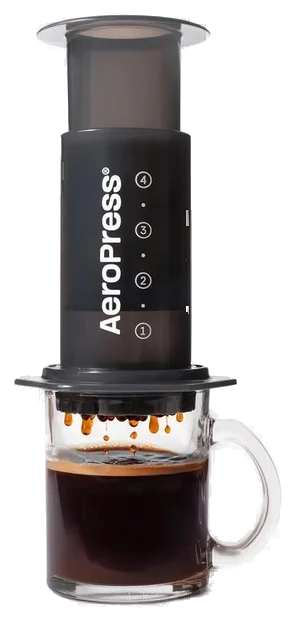
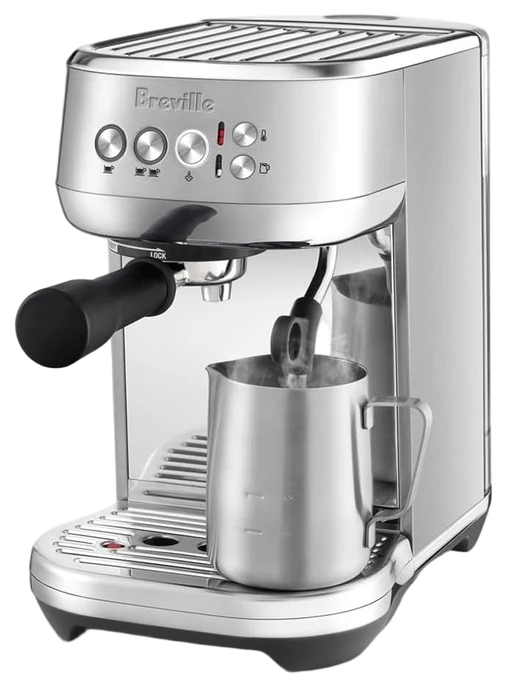
Most people who think they want an espresso machine are better served by the AeroPress; get the Breville Bambino Plus instead if flat whites are the actual point.
Best for milk drinks
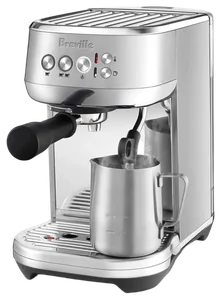
Breville Bambino Plus
~$400–500
Get it if you want lattes, flat whites or cappuccinos at home, and the budget stretches past the machine to a burr grinder as well.
Get it if you drink black coffee. Nothing else in the category returns this much cup quality for the money, and it stays useful as travel kit even if a machine follows later.
The price gap~$365–455 more for the Breville Bambino Plus
Breville Bambino Plus~$400–500
AeroPress~$35–45
Each bar is an estimated price range, on one scale from ~$35 to ~$500.
How we choseWe haven’t brewed with either one ourselves.
We compared brewing methods and what each can physically produce, total cost of ownership including grinders and consumables, published specifications, and long-term owner reports on daily use and abandonment. We haven’t brewed with either one ourselves; the output and durability claims come from published specs and long-term owner reports on daily use we drew on. Prices are always moving, so every button and link pulls the live listing.
How we rank
Published specifications, verified owner reviews, and independent safety or standards data where it applies — weighted the same for every pick, never sponsored placement.
The Breville Bambino Plus earns its place by doing the hard part automatically. Its thermojet heating system reaches brew temperature in about three seconds, so it is usable on a weekday morning, unlike machines that need fifteen minutes, and the automatic steam wand textures milk to a set temperature and consistency without you learning to freehand it. Serious Eats, which recommends it as the machine most people should start on, adds one caveat worth having in advance: the automatic shot-volume detection is not consistent, so stopping the shot by hand gives steadier results.
That last point is the whole argument. Milk steaming is the skill that takes months to develop, and it is what separates a decent home cappuccino from a sad one. The Bambino removes that barrier while still producing real 9-bar espresso, which means the coffee underneath the milk is espresso rather than strong filter coffee. Its footprint is also unusually small for a machine this capable.
The costs are larger than the sticker. It ships with pressurized baskets that flatter bad grind, and to get the most out of it you want the unpressurized baskets plus a proper burr grinder. Realistically another $150 to $250. There is no built-in grinder, the small water tank needs frequent refilling, and descaling is a genuine ongoing chore. At $400–500, buy it for milk drinks, not for black coffee.
Strengths
Three-second heat-up makes it usable daily
Automatic milk texturing removes the hardest skill
Real 9-bar espresso in a small footprint
Excellent value against traditional espresso machines
Tradeoffs
Needs a separate grinder to be worth it
Small water tank refills often
Descaling and cleaning are real ongoing chores
Best value~$35–45
2
AeroPress Original
Best value
Forty dollars, thirty seconds, coffee people prefer
Get it if you drink black coffee. Nothing else in the category returns this much cup quality for the money, and it stays useful as travel kit even if a machine follows later.
Skip it if you want milk drinks, or you are brewing for several people at once.
The AeroPress is the most disproportionate value in coffee. It is a plastic tube and a plunger, it costs about forty dollars, and it produces a clean, concentrated cup that a great many people prefer to espresso: low bitterness, low acidity, and enormously forgiving of grind size and technique. The World AeroPress Championship has run every year since a three-competitor evening in Oslo in 2008, and drew close to 8,000 entrants across 68 countries in 2025, which is a strange amount of professional attention for a plastic tube.
Its practical advantages are the ones you feel daily. It brews in about thirty seconds, cleans in about ten by ejecting the puck straight into the bin, needs no electricity, and is effectively indestructible: which makes it as good for travel and camping as for a kitchen counter. It is also the least fussy way to get good coffee out of ordinary beans, because there is no pressure profile to get wrong.
What it cannot do is milk. There is no steam wand and no way to add one, so lattes and cappuccinos are off the table unless you buy a separate milk frother, and even then you are frothing rather than texturing. It also makes one cup at a time, which is limiting for a household. And what it produces, strictly, is not espresso. At $35–45, none of that matters much. It is the correct first purchase for almost anyone.
Strengths
Outstanding coffee for about forty dollars
Brews in thirty seconds, cleans in ten
Forgiving of grind size and technique
Indestructible and needs no power
Tradeoffs
Cannot steam milk at all
One cup at a time
Not technically espresso
Espresso vs manual brewing FAQs
6 common questions, answered.
Do I really need a separate grinder?
For the espresso machine, yes. This is not optional. Espresso requires a fine, consistent, adjustable grind, and pre-ground supermarket coffee is neither fine enough nor fresh enough to produce a decent shot. A machine at this level with bad grind makes worse coffee than a $40 AeroPress with good grind. Budget $150 to $250 for a burr grinder alongside it. For the AeroPress, a grinder improves things noticeably but is optional. It works acceptably with pre-ground.
What does an espresso setup cost?
More than the machine. Realistically: the machine, a burr grinder, a tamper, a milk jug, and a scale: which pushes a Bambino setup to $600 to $800 before you have bought any coffee. Then descaling solution and cleaning tablets on an ongoing basis. This is the number that surprises people, and it is worth confronting before buying, because a half-built espresso setup produces worse coffee than a complete cheap one.
Is espresso better than AeroPress coffee?
Different, not better, and this is where a lot of money gets wasted. Espresso is a specific thing: a short, pressurized, intense extraction that forms the base for milk drinks. AeroPress produces a clean, full-bodied black coffee that many people, including plenty of professionals, prefer to drink on its own. If your honest goal is ‘a really good black coffee in the morning’, the AeroPress is not the compromise option. It may be the right answer.
How long does the learning curve take?
For the AeroPress, one cup. It is close to impossible to make something undrinkable. For espresso, expect a few weeks of adjusting grind size, dose and timing before shots are consistent, even with an automatic milk wand doing the hardest part. This matters because it is where most home espresso machines fail, not through breaking, but through the owner giving up in week three and going back to the kettle.
What about a drip machine or a pod machine instead?
Both are legitimate, and worth being honest about. A good drip machine is the right answer if you brew several cups at once and want it hands-off. It beats an AeroPress for volume comfortably. Pod machines make consistent, convenient coffee at a high cost per cup and with packaging most people would rather avoid. What neither does is give you control over the result. Choose based on volume and convenience versus control, not on what looks most serious.
When is coffee gear cheapest?
Espresso machines discount sharply during the late-November sales and again around the mid-year sales event, frequently by $100 or more on machines at this level. Grinders follow the same pattern. The AeroPress rarely discounts much because it is cheap already, but bundles including filters and a scale appear around the holidays. Refurbished espresso machines direct from manufacturers are also a strong option and carry a real warranty.
Prices on this page are re-checked weekly — see the full Home & Kitchen price index for every product we cover.
New guides, re-ranked picks and the month's notable changes. No weekly filler, ever.
Unsubscribe any time. Your address goes to our newsletter provider and nowhere else — see our privacy policy.
Manage Consent
To provide the best experiences, we use technologies like cookies to store and/or access device information. Consenting to these technologies will allow us to process data such as browsing behavior or unique IDs on this site. Not consenting or withdrawing consent, may adversely affect certain features and functions.
Functional
Always active
The technical storage or access is strictly necessary for the legitimate purpose of enabling the use of a specific service explicitly requested by the subscriber or user, or for the sole purpose of carrying out the transmission of a communication over an electronic communications network.
Preferences
The technical storage or access is necessary for the legitimate purpose of storing preferences that are not requested by the subscriber or user.
Statistics
The technical storage or access that is used exclusively for statistical purposes.The technical storage or access that is used exclusively for anonymous statistical purposes. Without a subpoena, voluntary compliance on the part of your Internet Service Provider, or additional records from a third party, information stored or retrieved for this purpose alone cannot usually be used to identify you.
Marketing
The technical storage or access is required to create user profiles to send advertising, or to track the user on a website or across several websites for similar marketing purposes.