The Best Learning Toys:The Ones That Survive the First Month
Most educational toys are played with twice and then ignored. We compared open-ended play value, published age ranges, material safety standards, and years of parent feedback to find the ones children keep returning to.
By the BYB Editorial Team
Published July 29, 2026 · Prices checked OctoberOct 5, 2026
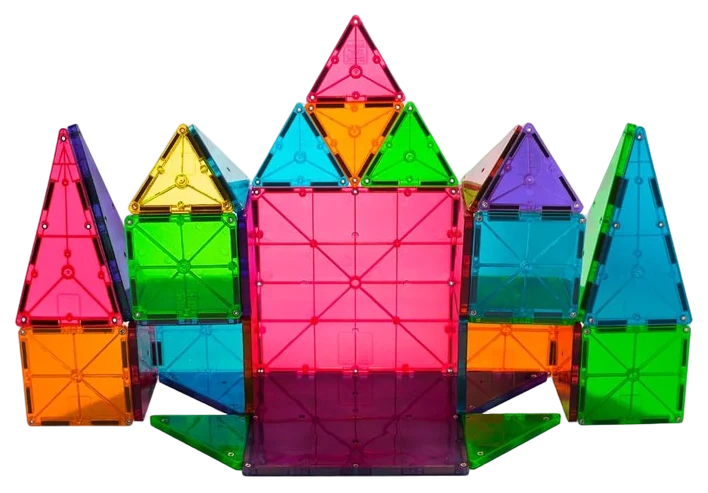
Magna-Tiles Magnetic Building Set$18–100The Magna-Tiles, $18–100 depending on set size — a magnetic tile has no correct answer and therefore no finish line.Check price
Slightly older
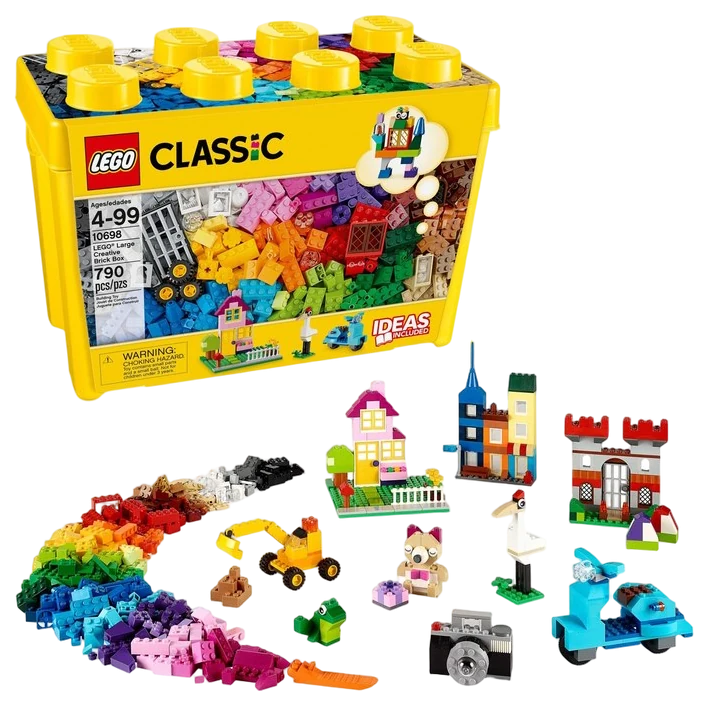
LEGO Classic Large Creative Brick Box$33–60LEGO Classic Large Creative Brick Box, $33–60 — does the same job in brick form.Check price
Before buying anything labeled educational
Ask: can it be used more than one way? If not, it’s finished the day it’s solved.
We compared open-ended play value against single-outcome design, published age grading and small-parts warnings, material and finish safety disclosures, and multi-year parent reports on how long each toy stayed in rotation.How we chose·How we verify·Corrections logged publicly
Most educational toys are played with twice and then ignored. We compared open-ended play value, published age ranges, material safety standards, and years of parent feedback to find the ones children keep returning to.
How we choseWhat we compared, and how we rank
We compared open-ended play value against single-outcome design, published age grading and small-parts warnings, material and finish safety disclosures, and multi-year parent reports on how long each toy stayed in rotation. Prices are always moving, so every button and link pulls the live listing.
How we rank
Published specifications, verified owner reviews, and independent safety or standards data where it applies — weighted the same for every pick, never sponsored placement.
Each bar is an estimated price range, on one scale from ~$16 to ~$100.
Pick 1 of 5: No. 1Best overall
1
Magna-Tiles Magnetic Building Set
Top pickBest overall
The one toy that spans toddler to primary school
Get it if you want a single construction toy that stays in rotation from age three through elementary school, and you are willing to start with at least a hundred-piece set so the early builds do not feel thin.
Skip it if you already own a large magnetic-tile set from any brand.
If a household buys one open-ended construction toy, Magna-Tiles is the most defensible choice. Magnets in every edge mean structures snap together on the first attempt, which removes the frustration that ends most three-year-olds’ engineering careers, and the translucent colors make the results attractive to look at and to hold up to a window.
The unusual thing is the age range. A three-year-old lays them flat and makes patterns, a five-year-old folds them up into cubes and houses, an eight-year-old builds ball runs and geometric structures that teach real spatial reasoning.
Few toys stay in rotation across five years, and the brand has an unusually clean track record to back that up: Magna-Tiles’ own FAQ states the company has never issued a product recall in more than 25 years on the market, a point Good Housekeeping Institute chief technologist Rachel Rothman has separately cited when recommending the brand, and every set is tested for compliance with the Consumer Product Safety Improvement Act, the federal law governing safety testing for children’s products.
None of that guarantees any single tile survives a toddler, but it is a longer clean record than most magnetic-tile brands can claim. They are expensive per piece, and small starter sets are frustrating, so plan for at least a hundred pieces before the interesting builds are possible and consider a storage bin with a lid, because loose tiles migrate. Cheaper magnetic tile brands exist and mostly work, though weld quality varies. At $18–100 depending on set size, it is the toy with the longest useful life here.
Strengths
Open-ended across five years of ages
Magnets make early success easy
Welded construction survives multiple children
Teaches real spatial and geometric thinking
Tradeoffs
Expensive per piece
Small sets are frustratingly limited
Tiles scatter and need dedicated storage
Pick 2 of 5: No. 2Best value
2
LEGO Classic Large Creative Brick Box
Best value
No instructions, which is the entire point
Get it if your child is four or older and you want the most open-ended building material per dollar on this list.
Skip it if your child is under four. The choking-hazard warning on the box is not boilerplate, so buy DUPLO instead and revisit this set in a year or two.
Licensed LEGO sets are built once, displayed, and eventually broken. The LEGO Classic Large Creative Brick Box deliberately does the opposite: a large assortment of standard bricks, wheels, windows, doors and eyes with no model to copy, which turns the box into raw material rather than a puzzle with one answer.
The value per hour is extraordinary. LEGO has kept the stud-and-tube coupling it patented in 1958 essentially unchanged since, so a brick from this box locks onto bricks made decades ago or decades from now, and the set combines with anything else the household acquires without becoming obsolete. Fine motor control, patience and planning all improve measurably through construction play, and unlike screen-based alternatives, a child can play with it alongside a sibling or a parent without taking turns.
The set’s own packaging carries a small-parts choking-hazard warning and a recommended age of four and up, not three, which is the real line for this box, and larger DUPLO bricks are the correct product for toddlers. It also demands storage discipline, because loose bricks spread relentlessly and are famously painful underfoot. At $33–60, it is the cheapest long-lived toy on this page.
Strengths
Completely open-ended with no instructions
Compatible with every other LEGO set
Builds fine motor control and planning
Excellent value for the number of pieces
Tradeoffs
Choking hazard under about four years
Requires real storage discipline
Painful to stand on, permanently
Pick 3 of 5: No. 3Best for toddlers
3
Hape Pound & Tap Bench
Best for toddlers
Cause and effect, delivered by hammer
Get it if you need one durable, safety-certified toy that can hold a one- to two-year-old’s attention through a hundred repetitions a day.
Skip it if noise is a serious constraint in your home, or your child is already close to three. The interest window closes fast.
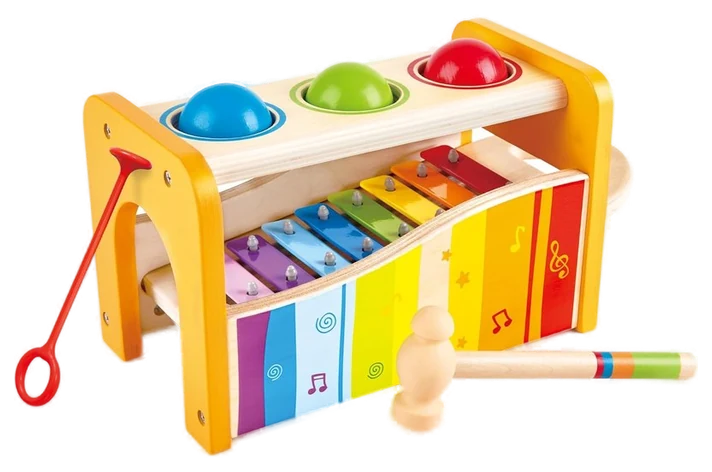
Toddlers are learning one enormous idea, which is that their actions cause outcomes, and the Hape Pound & Tap Bench teaches it with unusual clarity. Hammer a ball through the top, it drops onto a slide, rolls down, and plays notes on a xylophone at the bottom. The chain of cause and effect is visible, audible, and repeatable a hundred times an afternoon.
The build quality is why it survives that hundred. Hape’s own product page states the bench meets both EN 71 and ASTM F963, the European and American toy safety standards, and that its finish is water-based and non-toxic rather than the thin painted plastic of most first toys; The Toy Insider carries it as a standing pick in its own toddler-toy coverage. The xylophone slides out to be played separately, which effectively gives you two toys.
Hand-eye coordination, grip strength and early rhythm all get exercised without any of it feeling like instruction to the child. It is loud, because this is a hammer and a xylophone and no design can change that. It is also outgrown fairly quickly, usually somewhere around age three, so its life is shorter than the other picks, and the mallet needs supervision with younger toddlers. Pair it with a set of stacking cups for quieter play. At $30–45, it is the best first learning toy available.
Strengths
Teaches cause and effect unusually clearly
Solid wood with child-safe finishes
Xylophone detaches as a second toy
Builds grip strength and coordination
Tradeoffs
Loud
Outgrown by around age three
Mallet needs supervision early on
Also on the shortlist
Two more, in brief
Pick 4 of 5: No. 4Best classic~$16–25
4
Melissa & Doug Wooden Building Blocks
Budget pickBest classic
The oldest toy on this list and still one of the best
Get it if you want an inexpensive, FSC-certified classic that teaches real balance and structure through trial and error.
Skip it if you already own magnetic tiles and have limited shelf space. Your child will likely reach for those first anyway.
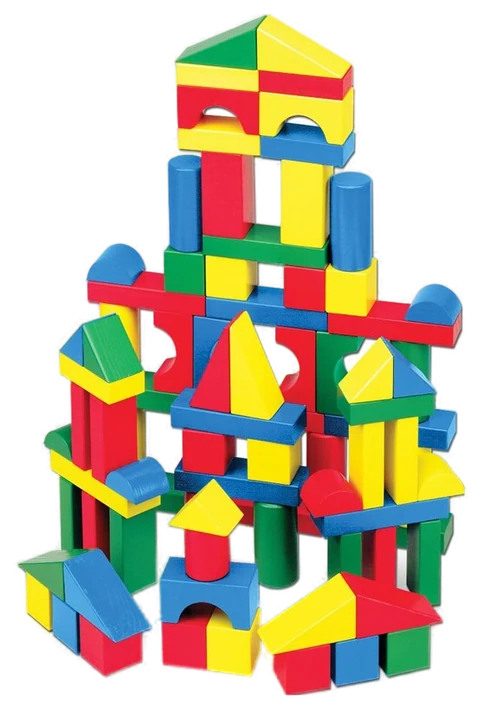
Wooden blocks predate every other toy here by roughly a century and still hold their place, because they impose real physics. The Melissa & Doug wooden building blocks set is the reliable version: solid hardwood in assorted shapes and sizes, heavy enough that a tower stands, and unforgiving enough that a badly balanced one falls.
That failure is the education. Unlike magnetic tiles, which forgive poor structural decisions, blocks require a child to discover balance, symmetry and load-bearing by trial. They also work brilliantly as shared play, since two children can build together with no turn-taking friction, and they combine naturally with the toy vehicles, animals and figures a household already owns. The set is FSC-certified, meaning the wood is sourced under Forest Stewardship Council chain-of-custody rules, and it is tested to ASTM F963, the toy safety standard the Consumer Product Safety Commission enforces.
Finishes on wooden toys have periodically been the subject of recalls across the industry regardless, so buy from a mainstream retailer and check current recall notices. The set is also less immediately exciting than the magnetic tiles, so children who own both often reach for the tiles first. Store them in a canvas toy basket. At $16–25, it is a cheap, permanent addition to a playroom.
Strengths
Real physics teaches genuine balance and structure
Excellent for shared play between children
Combines with vehicles, figures, and animals
Inexpensive and effectively indestructible
Tradeoffs
Less immediately exciting than magnetic tiles
Heavy blocks can hurt when knocked over
Worth checking current recall notices before buying
Pick 4 of 5: No. 4Best classic~$16–25
Melissa & Doug Wooden Building Blocks
The oldest toy on this list and still one of the best
Get it if you want an inexpensive, FSC-certified classic that teaches real balance and structure through trial and error.
Skip it if you already own magnetic tiles and have limited shelf space. Your child will likely reach for those first anyway.
Wooden blocks predate every other toy here by roughly a century and still hold their place, because they impose real physics. The Melissa & Doug wooden building blocks set is the reliable version: solid hardwood in assorted shapes and sizes, heavy enough that a tower stands, and unforgiving enough that a badly balanced one falls.
Read the full case
That failure is the education. Unlike magnetic tiles, which forgive poor structural decisions, blocks require a child to discover balance, symmetry and load-bearing by trial. They also work brilliantly as shared play, since two children can build together with no turn-taking friction, and they combine naturally with the toy vehicles, animals and figures a household already owns. The set is FSC-certified, meaning the wood is sourced under Forest Stewardship Council chain-of-custody rules, and it is tested to ASTM F963, the toy safety standard the Consumer Product Safety Commission enforces.
Finishes on wooden toys have periodically been the subject of recalls across the industry regardless, so buy from a mainstream retailer and check current recall notices. The set is also less immediately exciting than the magnetic tiles, so children who own both often reach for the tiles first. Store them in a canvas toy basket. At $16–25, it is a cheap, permanent addition to a playroom.
Strengths
Real physics teaches genuine balance and structure
Excellent for shared play between children
Combines with vehicles, figures, and animals
Inexpensive and effectively indestructible
Tradeoffs
Less immediately exciting than magnetic tiles
Heavy blocks can hurt when knocked over
Worth checking current recall notices before buying
Pick 5 of 5: No. 5Best screen-based learning
5
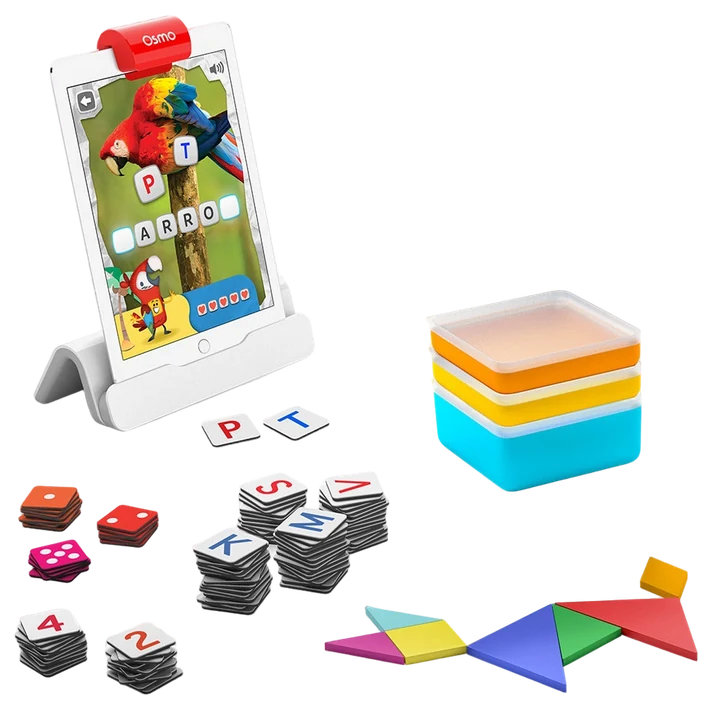
Osmo Genius Starter Kit
Best screen-based learning
Screen time that requires physical pieces on the table
Get it if tablet time is already happening, your tablet runs iPadOS 15 or later, and you want that time doing something closer to a worksheet than a video.
Skip it if you are trying to reduce screen time overall, or your only tablet is on Osmo’s excluded-device list.
If screen time is happening anyway, the Osmo Genius Starter Kit is the most defensible version of it. A mirror clips over a tablet’s camera so the device can see the table in front of it, and the child solves problems by arranging physical number tiles, letter tiles and drawings. The answer happens with hands, not with taps.
The activities cover early math, spelling, spatial puzzles and drawing, and the software adapts difficulty as the child improves, which keeps it from becoming trivially easy or discouraging. Parents consistently report that it holds attention like a game while producing the kind of practice a worksheet would, and that children will choose it over passive video when both are offered. ScienceBasedKids.com built an entire review around fact-checking Osmo’s own marketing claim that kids using the system learn 6x faster, the kind of scrutiny worth applying before taking any single stat on the box at face value.
This one has a real limit. Osmo’s own compatibility page requires iPadOS 15 or later and specifically excludes the original iPad 1 through 4, the first-generation iPad Air, and iPad mini 1 through 3, so a tablet you already own may not qualify, which makes the true cost higher than it looks; it is still screen time, and it is the least open-ended toy here, with defined activities rather than free play. Check current device compatibility before buying, since support varies by tablet generation. At $40–85, it is the pick for turning existing tablet time into something better.
Strengths
Physical pieces make screen time active
Adapts difficulty as the child improves
Covers math, spelling and spatial reasoning
Children choose it over passive video
Tradeoffs
Requires a compatible tablet you already own
Still screen time, however well designed
Defined activities rather than free play
Pick 5 of 5: No. 5Best screen-based learning
Osmo Genius Starter Kit
Screen time that requires physical pieces on the table
Get it if tablet time is already happening, your tablet runs iPadOS 15 or later, and you want that time doing something closer to a worksheet than a video.
Skip it if you are trying to reduce screen time overall, or your only tablet is on Osmo’s excluded-device list.
If screen time is happening anyway, the Osmo Genius Starter Kit is the most defensible version of it. A mirror clips over a tablet’s camera so the device can see the table in front of it, and the child solves problems by arranging physical number tiles, letter tiles and drawings. The answer happens with hands, not with taps.
Read the full case
The activities cover early math, spelling, spatial puzzles and drawing, and the software adapts difficulty as the child improves, which keeps it from becoming trivially easy or discouraging. Parents consistently report that it holds attention like a game while producing the kind of practice a worksheet would, and that children will choose it over passive video when both are offered. ScienceBasedKids.com built an entire review around fact-checking Osmo’s own marketing claim that kids using the system learn 6x faster, the kind of scrutiny worth applying before taking any single stat on the box at face value.
This one has a real limit. Osmo’s own compatibility page requires iPadOS 15 or later and specifically excludes the original iPad 1 through 4, the first-generation iPad Air, and iPad mini 1 through 3, so a tablet you already own may not qualify, which makes the true cost higher than it looks; it is still screen time, and it is the least open-ended toy here, with defined activities rather than free play. Check current device compatibility before buying, since support varies by tablet generation. At $40–85, it is the pick for turning existing tablet time into something better.
Strengths
Physical pieces make screen time active
Adapts difficulty as the child improves
Covers math, spelling and spatial reasoning
Children choose it over passive video
Tradeoffs
Requires a compatible tablet you already own
Still screen time, however well designed
Defined activities rather than free play
The best learning toy is the one your kid keeps coming back to, so match it to their age and leave room for open-ended play.
Match the age, and watch the small parts: anything with pieces small enough to swallow is a no under 3. Check the age label, it’s about choking hazards, not just difficulty.
Favor open-ended over one-trick: blocks, tiles, and bricks get played with for years because there’s no single “right” answer. A toy that does one thing gets boring fast.
Decide screen or no screen up front: some picks teach coding or math without a tablet at all, others need one. Know which camp you want before you buy.
The common mistake: buying flashy battery-powered toys that do the playing for your kid, or buying two years ahead. A simpler toy they can use today beats an impressive one that sits in the closet.
LEGO DUPLO Classic Brick Box — our LEGO Classic pick is rated 4+, and these bigger DUPLO bricks are built for the 1.5-to-4 crowd without the small-part worry. A better fit if your kid isn’t ready for standard LEGO yet.
Snap Circuits Jr. SC-100 — real snap-together electronics with over 100 projects for ages 8 and up. We kept the main list broad, but this is the pick once a kid outgrows building sets and wants to see how things work.
Learning Resources Botley 2.0 — a coding robot that teaches sequencing with zero screens, using a remote and cards. Our Osmo pick needs a tablet; this one doesn’t, if you’d rather keep coding off a device.
Learning toy FAQs
6 common questions, answered.
What makes a toy educational?
Open-endedness, more than any label on the box. A toy with one correct outcome, where you press the button and hear the animal, is finished as soon as the child masters it, usually within days. A toy that can become fifty different things sustains problem solving, storytelling and planning for years. That is why blocks, bricks and construction sets keep appearing in child-development research while battery-powered talking toys generally do not. The second factor is whether an adult or sibling can join in, since social play drives language development more than solo play does.
How many toys should a child have?
Fewer than most homes contain. Research on toddler play consistently finds that children in an environment with fewer toys play longer and more inventively with each one, because attention is not constantly pulled to the next option. A practical approach is rotation: keep a small selection accessible and store the rest, swapping every few weeks. Toys returning from storage get treated as new. This also solves the storage problem that every pick on this page creates.
What do the age ratings on toys mean?
They are primarily safety ratings, not ability ratings. A rating of three and up almost always signals a choking hazard from small parts rather than a claim about developmental readiness, which is why a capable two-year-old should still not be given a small-brick set unsupervised. Above that threshold, ratings become a rough guide to interest and difficulty, and children vary widely. Read the specific warning text on the box rather than the headline number.
Are wooden toys better than plastic ones?
Not automatically, though they have real advantages. They are more durable, pleasant to handle, need no batteries, and avoid the plastics debate entirely. The caveats are that finishes and paints matter, since wooden toys have been recalled over coatings, and that weight makes them more likely to hurt when thrown or knocked over. Buy from established brands through mainstream retailers, look for compliance with the relevant toy safety standard, and check for current recalls before purchase.
Is educational screen time worthwhile?
It depends almost entirely on whether the child is producing or consuming. Passive video is close to useless developmentally for young children. Interactive learning that requires the child to solve, arrange or create, like the tablet-based pick here, sits much closer to a worksheet or a game than to television, and can be a reasonable use of screen time that is already happening. It is not a replacement for physical, social play, and most guidance still favors strict limits on total screen hours for young children.
When are toys cheapest?
The deepest discounts land in the two weeks after the December holidays, when retailers clear seasonal stock, and again in late summer before the fall range arrives. Major sale events in late November discount heavily but on a narrower selection. Construction sets and building toys hold their prices better than licensed character toys, which crash hardest once a film leaves theaters. Buying larger sets rather than repeatedly adding small expansions is also consistently better value per piece.
Sources
Who the write-ups above lean on, and where each one is cited.
Good HousekeepingCited for Magna-Tiles.
ASTMCited for Hape Pound & Tap and Melissa & Doug Wooden Building Blocks, and in the buying advice.
CPSCCited for Melissa & Doug Wooden Building Blocks, and in the buying advice.
Prices on this page are re-checked weekly — see the full Baby & Kids price index for every product we cover.
Keep reading
Where to go next.
The close calls side by side, then related guides.
New guides, re-ranked picks and the month's notable changes. No weekly filler, ever.
Unsubscribe any time. Your address goes to our newsletter provider and nowhere else — see our privacy policy.
Manage Consent
To provide the best experiences, we use technologies like cookies to store and/or access device information. Consenting to these technologies will allow us to process data such as browsing behavior or unique IDs on this site. Not consenting or withdrawing consent, may adversely affect certain features and functions.
Functional
Always active
The technical storage or access is strictly necessary for the legitimate purpose of enabling the use of a specific service explicitly requested by the subscriber or user, or for the sole purpose of carrying out the transmission of a communication over an electronic communications network.
Preferences
The technical storage or access is necessary for the legitimate purpose of storing preferences that are not requested by the subscriber or user.
Statistics
The technical storage or access that is used exclusively for statistical purposes.The technical storage or access that is used exclusively for anonymous statistical purposes. Without a subpoena, voluntary compliance on the part of your Internet Service Provider, or additional records from a third party, information stored or retrieved for this purpose alone cannot usually be used to identify you.
Marketing
The technical storage or access is required to create user profiles to send advertising, or to track the user on a website or across several websites for similar marketing purposes.