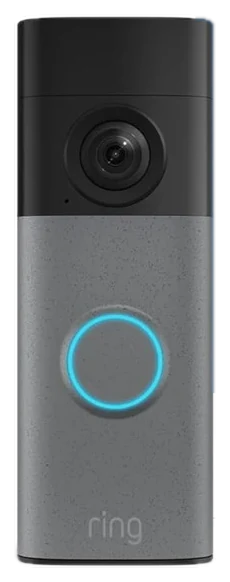
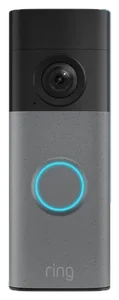
Get the name right before you shop, because Ring’s lineup has multiplied. The mainstream battery model is now the Battery Doorbell 2K, which Ring also sells as the Battery Doorbell (2nd Gen). It lists at $99.99, drops to $69.99 often enough that $60 to $100 is the honest range, and it is not any of the Plus, Pro, or wired variants.
It records what Ring calls Retinal 2K at 1920×1920 across a 140-by-140-degree head-to-toe view, mounts on push pins in minutes, and can trickle-charge off doorbell wiring or a solar panel. TechGearLab measured roughly 1% battery drain a day, about three months between charges.
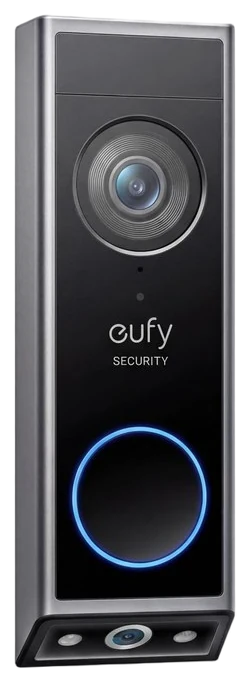
The camera is where the Ring gives ground. Testing the previous 1440p generation, TechGearLab found the very wide lens distorts badly toward the edges and the footage pixelated enough that testers could not read the color accuracy chart at all — one of the group’s lowest video scores — while rating the app 8.2 for ease of use. That split is the product in one line: best-in-class software, mid-pack glass. The 2nd Gen’s 2K sensor should narrow the gap, but nobody has lab-tested it against the eufy yet, so treat the resolution bump as a spec rather than a result.
Then the subscription, which is the actual price. Without a plan the doorbell still rings your phone, shows live view, and does two-way talk; it never saves anything, and TechGearLab put it plainly, that it does not let you go back and review anything without subscribing. Ring renamed its plans on January 14, 2026.
Ring Solo is $4.99 a month or $49.99 a year and covers one device with up to 180 days of history. Ring Multi is $9.99 or $99.99 and covers every device at one address. Ring Pro is $19.99 or $199.99 and adds Familiar Faces and professional monitoring. Security.org lists the same three tiers at the same prices. So: $149.98 the first year, $249.96 by year three, $399.96 if a second camera pushes you to Multi.