Both cost about the same, both are sold in every pharmacy, and they are formulated for genuinely different skin. We compared published ingredient lists, delivery systems, dermatologist commentary, and long-term user reports to work out who each one suits.
By the BYB Editorial Team
Published July 29, 2026 · Prices checked October 5, 2026
How we choseWe haven’t used either product on skin ourselves.
We compared published ingredient lists and supporting formulations, retinol delivery systems, dermatologist commentary on tolerance and irritation, packaging stability, and long-term user reports over months of continuous use. We haven’t used either product on skin ourselves; the tolerance and irritation claims come from dermatologist commentary and long-term user reports we drew on. Prices are always moving, so every button and link pulls the live listing.
How we rank
Published specifications, verified owner reviews, and independent safety or standards data where it applies — weighted the same for every pick, never sponsored placement.
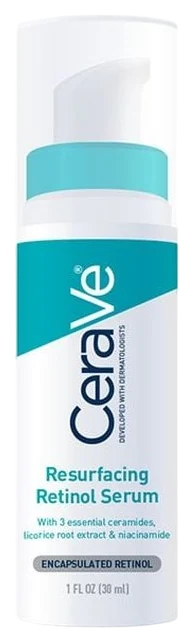
Most people who quit retinol quit in the first month, because their skin peeled and stung and they decided it was not for them. The CeraVe Resurfacing Retinol Serum is formulated around that failure. The retinol is encapsulated so it releases gradually rather than all at once. It sits alongside three ceramides and niacinamide, which support the skin barrier the retinol is temporarily disrupting.
That combination is why dermatologists recommend it as a starting retinol so consistently. TODAY’s Shop TODAY Beauty Awards, judged by a panel of dermatologists, has repeatedly named a CeraVe retinol serum its budget pick for beginners. It is aimed at post-acne marks and uneven texture rather than deep wrinkles, and it is fragrance-free and non-comedogenic, which matters if you are treating breakouts rather than aging. Users with reactive skin routinely report tolerating it nightly within a few weeks, which is unusual for any retinol.
The trade is potency. It is a gentle formulation, and if you have used retinoids for years it will feel like it is doing little. That is the design, not a defect. Results on texture take a couple of months of consistent use, and it will not touch established deep lines; that needs a prescription retinoid. At around $20, it is the least risky way to find out whether your skin gets on with retinol at all.
Strengths
Encapsulated release means far less irritation
Ceramides and niacinamide protect the barrier
Fragrance-free and non-comedogenic
The consensus dermatologist recommendation for beginners
Tradeoffs
Too gentle if you already use retinoids
Aimed at texture and marks, not deep lines
Results take a couple of months
Best for fine lines~$22–25
2
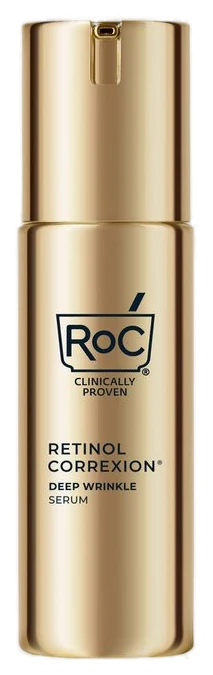
RoC Retinol Correxion Deep Wrinkle Serum
Best for fine lines
The stronger one, for skin that can already take it
Get it if your skin tolerates actives, fine lines are the target, and around $22–25 buys the stronger formula.
Skip it if you have never used retinol, or your skin reacts easily.
RoC Retinol Correxion has been on shelves for decades, which in skincare is a meaningful signal, and it won an Allure Best of Beauty award for exactly that track record. Formulations that do nothing do not survive that long in a category this crowded. It uses pure rather than encapsulated retinol at a higher effective strength, and it is aimed unambiguously at fine lines and wrinkles rather than texture or marks.
The practical difference is speed and depth. Users report visible change on fine lines around the eyes and mouth within roughly eight to twelve weeks, faster than the CeraVe will manage on the same concern. The airless packaging is a genuine formulation advantage. Retinol degrades on exposure to light and air, and a jar is the worst possible container for it.
The cost is tolerance. Pure retinol at this strength causes real purging and flaking in the first few weeks for most people, and on sensitive skin it can be unpleasant. It is not the product to learn on. Start twice weekly, buffer it with a plain ceramide moisturizer, and build up. At around $22–25, it is the more effective anti-aging option for skin that can handle it.
Strengths
Higher potency targets wrinkles directly
Visible fine-line change in eight to twelve weeks
Airless packaging protects the retinol
Decades of continuous use behind it
Tradeoffs
Real purging and flaking early on
Too harsh for sensitive or new-to-retinol skin
Not aimed at acne or post-acne marks
Retinol FAQs
6 common questions, answered.
How do I start retinol without wrecking my skin?
Slowly, and with less product than you think. Start twice a week, at night, on completely dry skin: applying to damp skin drives it in faster and increases irritation. Use a pea-sized amount for the whole face. Build to every other night over about a month, and only go nightly if your skin is comfortable. If you flake or sting, drop back a step rather than pushing through. The ‘sandwich’ method (moisturizer, retinol, moisturizer) is a legitimate way to buffer it on sensitive skin.
How long before I see anything?
Longer than the packaging implies. Texture and tone usually shift at around eight to twelve weeks. Fine lines take three to six months of consistent use. Anything deeper than fine lines is realistically the territory of prescription retinoids or in-office treatment, not an over-the-counter serum. The single biggest predictor of results is not which of these two you buy. It is whether you are still using it in month four.
What should I not use with retinol?
Do not layer it with other exfoliating acids (AHAs, BHAs) in the same routine; alternate nights instead. Avoid benzoyl peroxide at the same time of day, as it can deactivate some retinol formulations. Vitamin C is fine but is better used in the morning, with retinol at night. And if you are using prescription tretinoin, do not add an over-the-counter retinol on top; you are already at the stronger end.
Is sunscreen mandatory with retinol?
Yes, and this one is not negotiable. Retinol accelerates cell turnover, which leaves newer, more photosensitive skin at the surface: using it without daily broad-spectrum SPF undoes the benefit and can worsen the pigmentation you are treating. Apply SPF 30 or higher every morning, regardless of season or weather. If you will not commit to daily sunscreen, do not start retinol; you are spending money to make your skin more vulnerable.
Can I use retinol while pregnant or breastfeeding?
Standard medical guidance is to avoid retinoids during pregnancy, and that caution is usually extended to breastfeeding. This applies to over-the-counter retinol as well as prescription retinoids. Talk to your doctor or midwife about alternatives, azelaic acid and vitamin C are commonly suggested, rather than taking advice from a product page. This is a genuine medical question and not one to resolve from a buying guide.
Is the expensive stuff any better?
For retinol specifically, usually not. This is the clearest example in skincare of a category where the drugstore option competes directly with luxury pricing, because the active ingredient is inexpensive and well understood. What extra money can buy is better packaging, airless pumps protect retinol from light and air, and more elegant supporting formulations. Neither justifies a five-fold price difference. Both products here are the sensible tier.
Prices on this page are re-checked weekly — see the full Beauty price index for every product we cover.
New guides, re-ranked picks and the month's notable changes. No weekly filler, ever.
Unsubscribe any time. Your address goes to our newsletter provider and nowhere else — see our privacy policy.
Manage Consent
To provide the best experiences, we use technologies like cookies to store and/or access device information. Consenting to these technologies will allow us to process data such as browsing behavior or unique IDs on this site. Not consenting or withdrawing consent, may adversely affect certain features and functions.
Functional
Always active
The technical storage or access is strictly necessary for the legitimate purpose of enabling the use of a specific service explicitly requested by the subscriber or user, or for the sole purpose of carrying out the transmission of a communication over an electronic communications network.
Preferences
The technical storage or access is necessary for the legitimate purpose of storing preferences that are not requested by the subscriber or user.
Statistics
The technical storage or access that is used exclusively for statistical purposes.The technical storage or access that is used exclusively for anonymous statistical purposes. Without a subpoena, voluntary compliance on the part of your Internet Service Provider, or additional records from a third party, information stored or retrieved for this purpose alone cannot usually be used to identify you.
Marketing
The technical storage or access is required to create user profiles to send advertising, or to track the user on a website or across several websites for similar marketing purposes.