The Best Automatic Pet Feeders and Fountains for Scheduled Feeding
Automatic feeders and fountains are reliability purchases: the cheap ones jam and go stale. We compared jam rates, cleaning effort, and thousands of long-term owner reviews to find the four worth trusting.
By the BYB Editorial Team
Published July 28, 2026 · Prices checked OctoberOct 12, 2026
Automatic feeders and fountains are reliability purchases: the cheap ones jam and go stale. We compared jam rates, cleaning effort, and thousands of long-term owner reviews to find the four worth trusting.
How we choseWhat we compared, and how we rank
We compiled long-term owner reviews, reliability reports, and cleaning-effort comparisons across the category. Prices are always moving, so every button and link pulls the live listing.
How we rank
Published specifications, verified owner reviews, and independent safety or standards data where it applies — weighted the same for every pick, never sponsored placement.
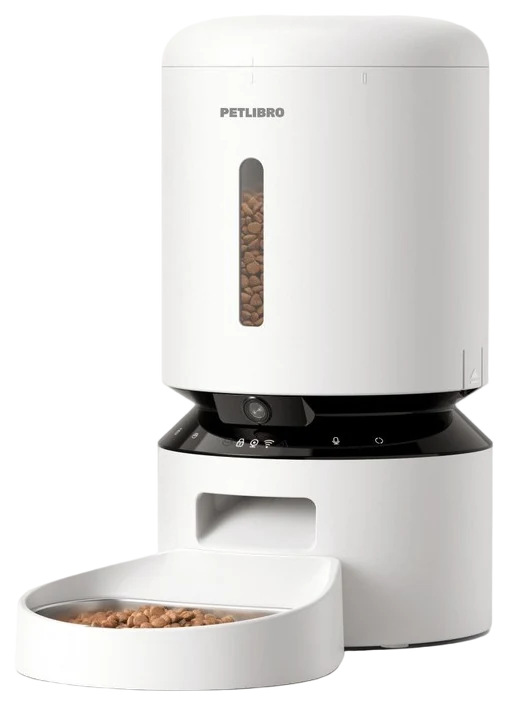
PETLIBRO owns this category in owner reviews for one unglamorous reason: Cats.com’s own review found it worked consistently, cleanly dispensing selected portions and passing every security test the reviewer threw at it, and the auger rarely jams, even with irregular kibble shapes, the failure that retires most feeders inside six months.
The competence stacks up: portioning accurate to the gram across one to six meals a day, a battery backup that carries outages, and a ten-second recordable meal call that’s sillier and more effective than it sounds. Owners on rotating shifts and travel schedules are its loudest fans.
It’s kibble-only, and the app (for the Wi-Fi variant) is functional rather than delightful. At $70–100 on Amazon, it’s the default answer for scheduled feeding. The machine that keeps working.
Strengths
Jam-resistant auger, proven
Gram-accurate portioning
Battery backup for outages
Recordable meal call works
Tradeoffs
Kibble only
App is functional, not fun
Hopper needs occasional washing
Pick 2 of 5: No. 2Best value~$25–40
2
Catit Flower Fountain
Budget pickBest value
The hydration multiplier
Get it if a cat’s water intake deserves engineering, which it does, and about $28 is cheap insurance.
Skip it if your cat already drinks like a champion, verify, then skip.
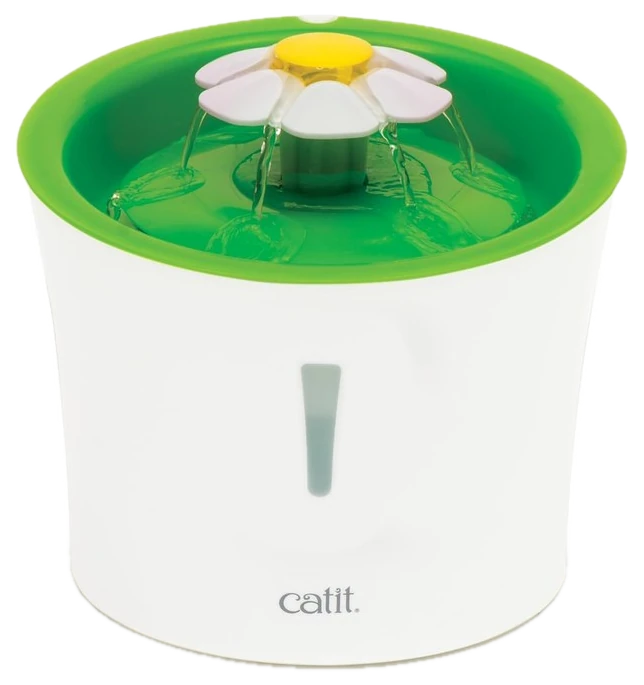
Cornell’s Feline Health Center pushes water intake for urinary health, and moving water is how you get a cat to comply. The Catit Flower Fountain’s three flow styles let picky drinkers choose their preference: gentle bubble, stream, or fountain arc.
Reviewed.com calls it a must-buy for cat owners, and at roughly thirty dollars it’s the cheapest meaningful health purchase in the pet aisle, with a decade of reviews behind the quiet pump and cheap filters. Most owners report visibly increased drinking within the first week.
Weekly cleaning is the cost of every fountain. This one disassembles fastest in the category, which is why it survives in households where fancier fountains got retired. At about $28, it’s preventive medicine disguised as a planter.
Strengths
Three flows suit picky drinkers
Cheapest real health upgrade here
Fastest-cleaning teardown
Decade-deep review record
Tradeoffs
Weekly cleaning, non-negotiable
Filter restocks recur
Motor eventually ages. Pumps are cheap
Pick 3 of 5: No. 3Best for multi-pet homes~$110–150
3
PETKIT YumShare Dual-Hopper Feeder
Upgrade pickBest for multi-pet homes
The two-pet peacekeeper
Get it if two pets eat different foods on different clocks, and $110–150 for two hoppers beats buying two machines.
Skip it if one pet, one diet. The PETLIBRO does it for less.
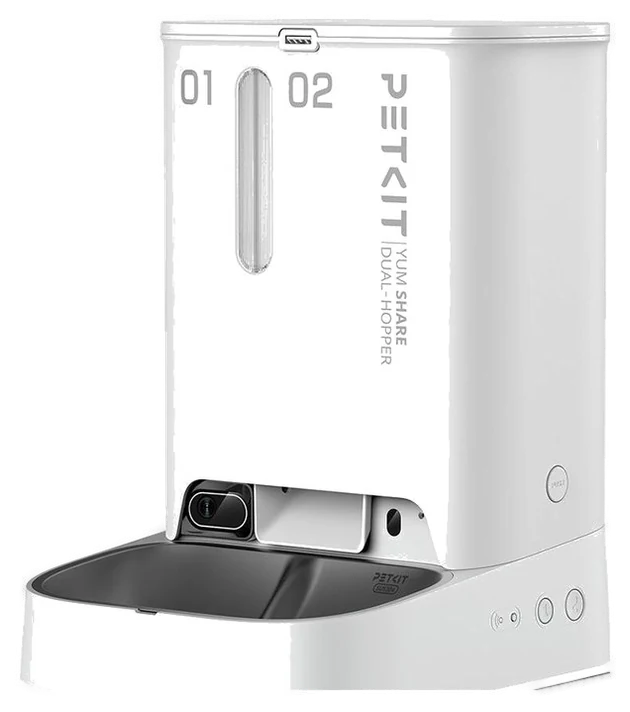
Feeding two pets different foods on different schedules breaks most feeders. The PETKIT YumShare’s split hopper handles two diets independently, the multi-pet household’s actual problem, solved in hardware.
The built-in 1080p camera answers the anxious-owner question. Did they eat?, from anywhere, with meal footage as the receipt. Per-pet schedules and portions run independently per hopper side. Portion logs per pet also settle the who-ate-whose-food mystery that multi-pet homes know too well.
Reviews flag the app as merely okay; the hardware is the draw, and the price reflects the double machinery. At $110–150 on Amazon, it’s the answer for the diet-cat-plus-gulper-dog household nothing else serves.
Strengths
Two diets, two schedules, one machine
Camera confirms meals happened
Independent per-side portions
Solves the true multi-pet problem
Tradeoffs
App trails the hardware
Double-hopper pricing
Bigger countertop footprint
Also on the shortlist
Two more, in brief
Pick 4 of 5: No. 4Best for anxious owners
4
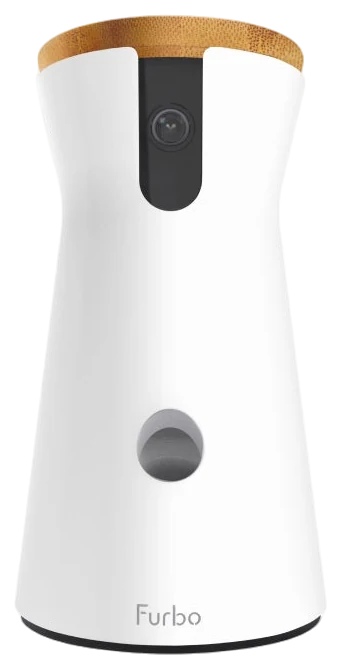
Furbo 360° Dog Camera
Best for anxious owners
The treat-tossing check-in
Get it if leaving the dog home alone is the hard part of your day.
Skip it if your dog sleeps through your absence, lucky both of you.
The Furbo 360 earns its place beside feeders because it solves the same owner problem, being away, from the emotional side: a 360-degree camera that follows the dog, bark alerts that flag distress, and a treat cannon that turns check-ins into a game.
Price this one with the plan in mind. Furbo sells the 360 two ways: about $72 for a unit that will not switch on without its Furbo Nanny subscription, roughly $7 to $10 a month with a three-month minimum, or $184 for the same camera with no plan requirement at all. Cancel after the minimum and the core features stay; the AI alerts and cloud video history go with the plan. Judge it on the first-year cost rather than the sticker.
Separation-anxiety households rate it among their best purchases: the ability to see, speak, and reward from a desk defuses the worst-case imagination loop for owner and (with practice) dog alike.
The smart-alert features push a subscription, the core camera and treat toss work without it, which is the configuration most owners keep. At $72 with the plan or $184 outright on Amazon, it’s the guilt-reduction machine of the category.
Get it if leaving the dog home alone is the hard part of your day.
Skip it if your dog sleeps through your absence, lucky both of you.
The Furbo 360 earns its place beside feeders because it solves the same owner problem, being away, from the emotional side: a 360-degree camera that follows the dog, bark alerts that flag distress, and a treat cannon that turns check-ins into a game.
Read the full case
Price this one with the plan in mind. Furbo sells the 360 two ways: about $72 for a unit that will not switch on without its Furbo Nanny subscription, roughly $7 to $10 a month with a three-month minimum, or $184 for the same camera with no plan requirement at all. Cancel after the minimum and the core features stay; the AI alerts and cloud video history go with the plan. Judge it on the first-year cost rather than the sticker.
Separation-anxiety households rate it among their best purchases: the ability to see, speak, and reward from a desk defuses the worst-case imagination loop for owner and (with practice) dog alike.
The smart-alert features push a subscription, the core camera and treat toss work without it, which is the configuration most owners keep. At $72 with the plan or $184 outright on Amazon, it’s the guilt-reduction machine of the category.
Strengths
360° tracking follows the dog
Treat toss makes check-ins fun
Bark alerts flag real distress
Core works subscription-free
Tradeoffs
Best alerts want the subscription
Treat-size restrictions apply
Router-dependent, obviously
Pick 5 of 5: No. 5Best for wet food
5
Cat Mate C500 Digital 5-Meal Automatic Feeder
Best for wet food
Five sealed meals with ice packs, no app required
Get it if your cat or small dog eats wet food and you need a workday or overnight covered without leaving cans out to spoil.
Skip it if you feed dry food only, want app control or a camera, have a large dog, or need coverage longer than about 24 hours per fill.
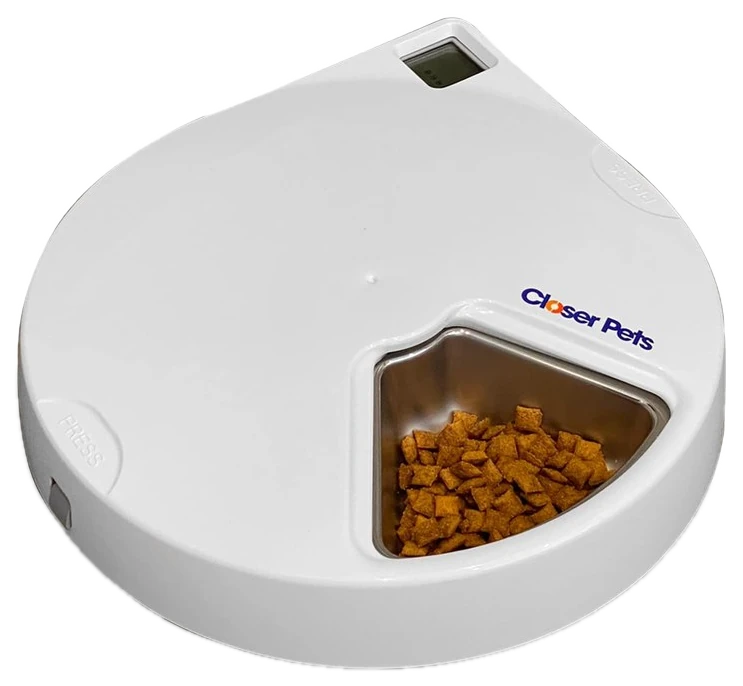
Unlike the dry-kibble feeders above, the Cat Mate C500 uses a rotating carousel of five compartments, each holding about 11.5 ounces of wet or dry food, on a digital timer that schedules up to roughly 90 hours ahead. One meal is open right away; up to four more stay sealed until their scheduled turn, kept cool underneath by twin snap-in ice packs. Closer Pets, the manufacturer, sells it direct at $45.99; Chewy carries it at the full $49.99 list.
Cats.com, whose reviewer ran the C500 with her own cats for several weeks, confirms the lid and tray are dishwasher safe while the base wipes clean and should never be submerged; PetsRadar notes the sealed design kept food fresh even in summer heat. There is no app, no WiFi, and no firmware, so nothing to pair and no server outages, and Cats.com reports that three AA batteries last up to a year.
Ice packs are not refrigeration: Cats.com puts the cooling window at roughly 12 hours to a day, covering a workday or an overnight but not a weekend away. It is battery-only with no outlet option, food can stick in the tray corners, and Cats.com notes the rotating tray’s sound can startle skittish cats. If your pet eats dry food and wants weeks of capacity with app scheduling, the PETLIBRO Granary above is the better buy, and large-breed dog owners will find the portions too small. But if canned food is non-negotiable, this is the slot built for you.
Strengths
Only pick in this guide designed for wet food, with twin ice packs included
Lid and tray are dishwasher safe, confirmed by both Cats.com and PetsRadar
Five 11.5 oz compartments cover an initial meal plus four timed feedings
No app or WiFi to fail; about a year of use from three AA batteries
Sold direct by Closer Pets and carried at Chewy and Amazon
Tradeoffs
Ice packs keep food cool for roughly 12 to 24 hours, not a weekend
Battery power only, with no outlet option as a backup
Food can lodge in tray corners, per Cats.com’s review
Get it if your cat or small dog eats wet food and you need a workday or overnight covered without leaving cans out to spoil.
Skip it if you feed dry food only, want app control or a camera, have a large dog, or need coverage longer than about 24 hours per fill.
Unlike the dry-kibble feeders above, the Cat Mate C500 uses a rotating carousel of five compartments, each holding about 11.5 ounces of wet or dry food, on a digital timer that schedules up to roughly 90 hours ahead. One meal is open right away; up to four more stay sealed until their scheduled turn, kept cool underneath by twin snap-in ice packs. Closer Pets, the manufacturer, sells it direct at $45.99; Chewy carries it at the full $49.99 list.
Read the full case
Cats.com, whose reviewer ran the C500 with her own cats for several weeks, confirms the lid and tray are dishwasher safe while the base wipes clean and should never be submerged; PetsRadar notes the sealed design kept food fresh even in summer heat. There is no app, no WiFi, and no firmware, so nothing to pair and no server outages, and Cats.com reports that three AA batteries last up to a year.
Ice packs are not refrigeration: Cats.com puts the cooling window at roughly 12 hours to a day, covering a workday or an overnight but not a weekend away. It is battery-only with no outlet option, food can stick in the tray corners, and Cats.com notes the rotating tray’s sound can startle skittish cats. If your pet eats dry food and wants weeks of capacity with app scheduling, the PETLIBRO Granary above is the better buy, and large-breed dog owners will find the portions too small. But if canned food is non-negotiable, this is the slot built for you.
Strengths
Only pick in this guide designed for wet food, with twin ice packs included
Lid and tray are dishwasher safe, confirmed by both Cats.com and PetsRadar
Five 11.5 oz compartments cover an initial meal plus four timed feedings
No app or WiFi to fail; about a year of use from three AA batteries
Sold direct by Closer Pets and carried at Chewy and Amazon
Tradeoffs
Ice packs keep food cool for roughly 12 to 24 hours, not a weekend
Battery power only, with no outlet option as a backup
Food can lodge in tray corners, per Cats.com’s review
Rotating tray noise can startle nervous cats
No app, camera, or remote scheduling of any kind
A feeder or fountain only helps if it runs for months without jamming, going stale, or dying in a power cut, so buy for reliability first.
Match the mechanism to the food: augers handle dry kibble; if you feed wet or fresh, you need a rotating-tray feeder instead, because an auger will smear it.
Check the backup power: the best feeders take batteries and plug in, so a blackout doesn’t turn into a missed meal.
Look at cleaning: pick parts you can pull out and rinse, ideally dishwasher-safe, since old food residue is where the smell and mold start.
Do the fountain filter math: a cheap fountain can cost more in replacement filters over a year, and the common mistake is letting the pump run dry so it burns out.
PetSafe Smart Feed Automatic Feeder — a capable feeder, but its app and Wi-Fi have a long history of dropping the connection, so go in knowing that if you want the app control.
Veken Pet Fountain — cheap and popular, but it’s mostly plastic and the little pump needs frequent cleaning or it gets loud.
PetSafe Drinkwell Platinum — big capacity and a nice free-falling stream, but it’s bulky with a lot of parts to scrub, which is overkill for one cat.
Feeder and fountain FAQs
6 common questions, answered.
Are automatic feeders safe for portion control?
Good augers portion accurately to within a few grams, which is better than scooping by eye. For weight-managed pets, pair scheduled portions with your vet’s daily gram target. The machines are more consistent than humans.
How often do fountains need cleaning?
Weekly wash, filter swap every 2–4 weeks. Skipping this is why fountains get bad reviews. Slime builds wherever water sits. Both fountains here disassemble without tools.
Do cameras and apps require subscriptions?
The PETLIBRO and PETKIT features here work subscription-free. Furbo pushes an optional Dog Nanny subscription for smart alerts, but live view and treat tossing work without it.
Do automatic feeders work with wet food?
The auger feeders here are kibble machines, wet food gums the mechanism and spoils in hoppers. Wet-food automation exists as a different device: refrigerated or ice-pack rotary feeders with sealed compartments, useful for single scheduled meals rather than all-day portioning. The practical household pattern: automate the kibble base with the PETLIBRO, serve wet food personally, which also preserves the one meal where you observe appetite, the best daily health check there is.
What happens to these devices during a power outage?
The PETLIBRO’s battery backup carries scheduled meals through outages (load real batteries, not intentions) and the PETKIT holds schedules through brief flickers. Fountains stop moving water; leave a backup bowl out and cats shrug. The camera-dependent Furbo goes dark with the router, outage or not. For long trips, the layered answer remains a human check-in every day or two; machines feed, but only people notice a limp.
How do I transition a pet to an automatic feeder?
Run the feeder beside the old bowl for a week dispensing nothing, so it stops being suspicious furniture. Then serve one familiar meal a day from it (same food, same time) before handing over the full schedule, and use the voice-recording call so meals announce themselves. Most pets convert in under two weeks; the anxious ones need you visibly absent from the dispensing moment, which is rather the point of the machine.
Prices on this page are re-checked weekly — see the full Pets price index for every product we cover.
Keep reading
Where to go next.
The close calls side by side, then related guides.
New guides, re-ranked picks and the month's notable changes. No weekly filler, ever.
Unsubscribe any time. Your address goes to our newsletter provider and nowhere else — see our privacy policy.
Manage Consent
To provide the best experiences, we use technologies like cookies to store and/or access device information. Consenting to these technologies will allow us to process data such as browsing behavior or unique IDs on this site. Not consenting or withdrawing consent, may adversely affect certain features and functions.
Functional
Always active
The technical storage or access is strictly necessary for the legitimate purpose of enabling the use of a specific service explicitly requested by the subscriber or user, or for the sole purpose of carrying out the transmission of a communication over an electronic communications network.
Preferences
The technical storage or access is necessary for the legitimate purpose of storing preferences that are not requested by the subscriber or user.
Statistics
The technical storage or access that is used exclusively for statistical purposes.The technical storage or access that is used exclusively for anonymous statistical purposes. Without a subpoena, voluntary compliance on the part of your Internet Service Provider, or additional records from a third party, information stored or retrieved for this purpose alone cannot usually be used to identify you.
Marketing
The technical storage or access is required to create user profiles to send advertising, or to track the user on a website or across several websites for similar marketing purposes.