Casio G-Shock DW-5600 vs. Timex Expedition Scout: Which Cheap Watch Survives Abuse
Our verdict
Get the Casio G-Shock DW-5600E-1V unless the extra water and shock protection is more than you need — then the Timex Expedition Scout is the cheaper, honest choice.
Best for shock resistance
~$50–100Estimated price
View on AmazonBest value
~$30–45Estimated price
View on Amazon
Side by side
Best for
Daily abuse and job sites
Everyday wear on a budget
Standout spec
200m water resistance, shock-resistant case
Indiglo backlight, mineral crystal
The price gap: ~$20–55 more for the G-Shock DW-5600.
Which one fits you
Best for shock resistance
G-Shock DW-5600
Get it ifyou want one watch that survives job sites and repeated bumps.
Skip it ifyou want an analog face or don’t need the extra durability.
Best value
Expedition Scout 40mm
Get it ifprice matters more than shock resistance and you want an Indiglo backlight.
Skip it ifyou need real shock resistance or want the highest water-resistance rating available.
What changed1 dated note · latest 27 September 2026
Our watches guide now picks the Timex Weekender over the Expedition Scout. This comparison stays up for anyone weighing the Expedition Scout.
Dated notes already published on this page, newest first. Every correction we make is logged on the corrections page.
Note, 27 September 2026Our watches guide now picks the Timex Weekender over the Expedition Scout. This comparison stays up for anyone weighing the Expedition Scout.Every correction we’ve made
Pick 1 of 2: Best for shock resistance
Casio G-Shock DW-5600E-1V
The shock-resistant original
~$50–100Estimated price
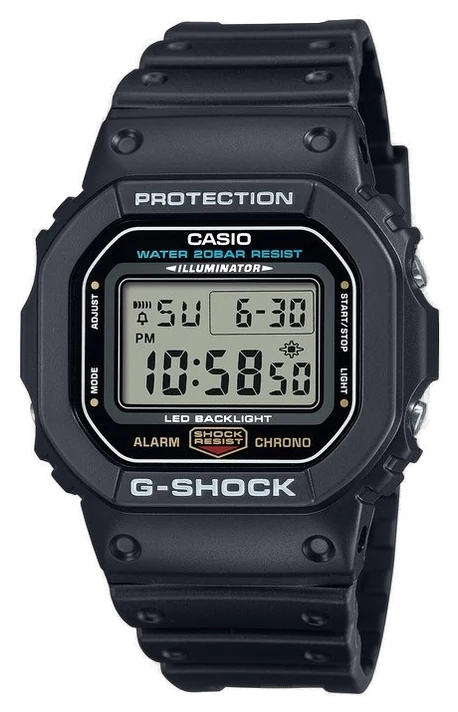
View on AmazonThe Casio G-Shock DW-5600E-1V is the same square case Casio built for the original G-Shock in 1983: a shock-resistant module suspended inside a resin case so an impact doesn’t reach the movement directly. The case and band are resin, the crystal is mineral glass, and Casio rates it to 200 meters under the ISO 22810 standard, a static test that doesn’t simulate a dive, which is why it isn’t marketed as a dive watch.
Digital features are basic but complete: a 1/100-second stopwatch, a 24-hour countdown timer, an alarm, and an auto-calendar accurate to about 15 seconds a month. The backlight lights the whole face at once, and it runs on one CR2016 battery rated at roughly two years. At about 42.8mm and built almost entirely from resin, it stays light on the wrist for something built to take an impact.
Where it loses ground is polish: the resin band and case look like a $50 watch, the display is small, and there’s no analog hand option. It’s also the pricier of these two once markups are counted. What you get for that gap is a shock-resistant design refined since 1983 and a 200-meter rating backed by a public standard. At $50–100, it’s the pick for forgetting you’re wearing it at work.
Strengths
- ISO 22810-rated 200m water resistance
- Shock-resistant resin case and module
- About two-year battery, easy to swap
- Backlight lights the whole face at once
Tradeoffs
- Looks like a tool watch, not dress
- No analog hand option
- Pricier than the Expedition Scout
- Busier display to read at a glance
Pick 2 of 2: Best value
Timex Expedition Scout 40mm
The budget analog pick
~$30–45Estimated price
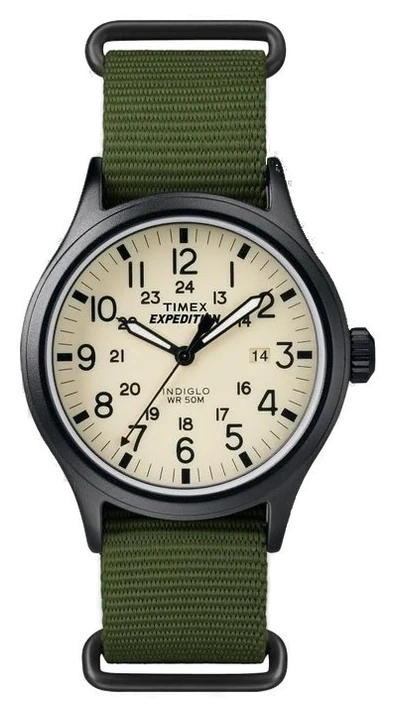
View on AmazonThe Timex Expedition Scout 40mm is a simple three-hand analog quartz watch built around Timex’s Indiglo backlight, the same electroluminescent panel Timex has used since the late 1980s: press a button and the whole dial lights an even blue-green. The 40mm case is brass with a light-alloy base, the crystal is mineral glass rather than the acrylic lens older Timex watches used, and Timex rates it to 50 meters of water resistance.
Timex’s own guidance is specific: fine for handwashing, light rain and light swimming, but not for snorkeling or poolside diving, and buttons shouldn’t be pressed while wet. The quartz movement runs on a single CR2016 battery, the dial adds a quick-set date window and a 12/24-hour display, and it ships on a fabric-and-leather or all-leather strap at a 20mm lug width fitting most replacement straps.
Where it gives ground to the G-Shock: mineral crystal scratches more easily than sapphire, and the lower water-resistance number means it should stay off the wrist past a splash or shallow swim. For daily wear that doesn’t involve a job site or hard knocks, the tradeoffs land in the Scout’s favor. At $30–45, it’s the pick for someone who wants a normal analog watch at a normal price, with Indiglo thrown in.
Strengths
- Costs less than half the G-Shock
- Indiglo backlight lights the whole dial
- Mineral crystal, not cheaper acrylic
- Standard 20mm lug fits most straps
Tradeoffs
- 50m rating covers light swimming only
- Not built for shock or impact
- Scratches easier than sapphire crystal
G-Shock vs. Timex FAQs
6 common questions, answered.
What does a 200-meter or 50-meter water-resistance rating mean on a watch?
Both numbers come from a static-pressure test under ISO 22810, the standard for everyday water-resistant watches: the watch sits still in a pressure tank holding the equivalent pressure of that depth for a set period. It doesn’t reproduce a dive, a wave, or a fast swimming stroke, all of which spike the real pressure past the rated number. A 200m rating gives more of a safety margin above ordinary use than a 50m rating does, but neither turns the watch into a dive watch.
Can I swim or shower with either of these watches?
The G-Shock DW-5600E-1V’s 200-meter rating comfortably covers showers, handwashing, and swimming. The Expedition Scout’s 50-meter rating is lower: Timex’s own guidance says it’s fine for handwashing and light swimming, but not for snorkeling or diving at the pool, and buttons shouldn’t be pressed while the watch is wet. If you shower or swim daily and want the bigger margin, the G-Shock is the safer pick of the two.
Which watch holds up better to physical work or sports?
The G-Shock DW-5600E-1V is built around exactly that: a shock-resistant module suspended inside a resin case, a design Casio has refined since the original 1983 G-Shock. The Expedition Scout wasn’t built around impact resistance in the same way — its mineral crystal and brass case handle everyday knocks fine, but it isn’t marketed or built as an impact-resistant tool watch.
How long do the batteries last, and can I replace them myself?
Both watches run on a single CR2016 battery. Casio rates the G-Shock’s battery at roughly two years per charge; the Expedition Scout’s quartz movement runs on a similar cycle. Either battery is a standard size any jeweler, watch-parts shop, or comfortable DIYer with a case-back tool can swap, so neither locks you into a brand-specific replacement or a mail-in service.
Is the Timex Expedition Scout’s crystal acrylic or mineral glass?
Current Expedition Scout models use mineral crystal, not the acrylic lens older Timex field watches were known for. Mineral crystal resists scratches better than acrylic, though it isn’t as scratch-resistant as the sapphire crystal found on pricier watches, and unlike acrylic it can’t be buffed to remove light scratches. For a watch in this price range, reviewers generally have no complaint with the tradeoff.
Which one should I buy if price is the deciding factor?
The Timex Expedition Scout 40mm costs less than half of what the G-Shock DW-5600E-1V runs at the top of its price range, and it still adds Timex’s Indiglo backlight and a mineral-crystal face most watches this cheap skip. Buy it if price is the deciding factor. Buy the G-Shock instead if the extra water resistance and shock protection are worth the higher price to you.
How we chose
We haven’t worn either watch ourselves.
We compared published manufacturer specifications: water-resistance ratings, case and crystal materials, battery type, and backlighting. We haven’t worn either watch ourselves; the water-resistance and backlight claims come from each brand’s published spec sheet and the ISO 22810 standard the Casio is rated against. Updated September 2026. Prices are always moving, so every button and link pulls the live listing.
How we rank
Published specifications, verified owner reviews, and independent safety or standards data where it applies — weighted the same for every pick, never sponsored placement.
Where to go next.
The close calls side by side, then related guides.